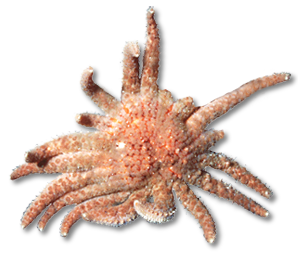
 Sea stars
 Locomotion
The topic of Sea stars: Locomotion is covered in 6 sub-sections:
- TUBE FEET
- ARM NUMBER
- RIGHTING RESPONSE
- LOCOMOTORY SPEED
- ROLE OF LIGHT PERCEPTION
- FUNCTION OF MADREPORITE
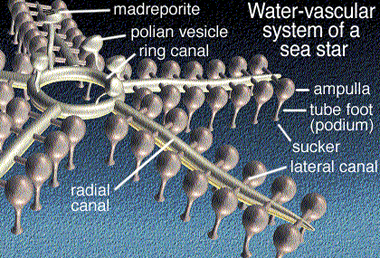
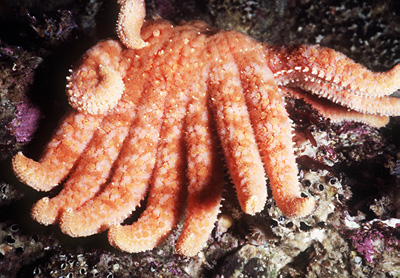
Locomotion of sea stars is via multiple tube feet that are part of a larger system of hydraulic ducting known as the water-vascular system. Hydraulic movement of fluid from storage sacs or ampullae to a tube foot (podia), accompanied by relaxation of longitudinal muscles, act to extend it (Fig. 1) . On contact with the substratum in most species the tube feet attach momentarily to the substratum by means of a sucker. Contraction of postural muscles at the proximal regions of the tube feet moves the body in relation to the tube feet for locomotion. Contraction of the longitudinal muscles in the tube feet pull them closer to the substratum for anchoring, or pull prey closer to the arms for feeding purposes. There is evidence that the madreporite acts as a conduit for at least some of the fluid present in the water-vascular system. The nervous system is sited close to the elements of the water-vascular system. It consists of a ring around the mouth and radial nerves running down each arm, with smaller nerves running to each tube foot. There are no ganglionic clusters and nothing equivalent to a brain. Other than moving in the same direction during locomotion, there is no coordination of stepping movements of the tube feet. The number of tube feet in a sea star is large (estimated in an adult sunflower star Pycnopodia helianthoides to be about 15,000), so precise control may in any case be beyond the capacity of the nervous system. It is common to see fast-moving sea stars, such as Pycnopodia, pulling themselves along with the tube feet on the leading half of the body and letting the arms on the back half of the body stream out behind, with little or no contact of tube feet with the substratum (Fig. 2).
This short account is meant as an overview. For more detail, select a topic from the menu above.