Sea stars
Locomotion: Function Of Madreporite
Fig. 1.  Water-vascular system of a sea star
Courtesy Cindy Young University of British Columbia

Locomotion by tube-foot crawling in echinoderms involves the water-vascular system that in sea stars originates from a central ring-canal hub and extends distally to the arm tips.  The tube feet connect to the water-vascular system via lateral canals, radial canals, and ring canal (Fig. 1).  From the ring canal a calcified “stone” canal (not labeled in the drawing) leads to the madreporite. The madreporite is visible externally as a porous plate, and is often distinctively coloured.  Because of the physical nature of the connection of the madreporite with the water-vascular system, it has long been thought to act as a conduit for entry of seawater for operation of the tube feet and/or for body-volume regulation.  However, unequivocal evidence for this is known only from relatively recent studies, and the function of water intake via the madreporite is still uncertain. 

NOTE a propos of this topic, one article on sea urchins is included here along with several for sea stars


Research Study 1

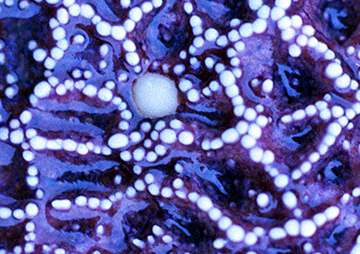
Fig. 1.  Madreporite of an ochre star Pisaster ochraceus, nestled amongst the spines on the aboral surface 

Studies on madreporite function in the ochre star Pisaster ochraceus  (Fig. 1) show that individuals with cement-obstructed madreporites do not maintain body volumes as well as normal animals. The author notes that the osmotic concentration of the water-vascular fluid in asteroids is higher than that of the pervisceral coelomic fluid and surrounding seawater.  Since water would move into the system osmotically from both sources, the question arises as to why there would be need for an auxiliary source of fluid via the madreporite? The author suggests that while the madreporite is involved with maintenance of general body volume, it is not involved significantly with inflation of the tube feet, where osmotic factors appear to dominate.  In this regard, it is known that the tube feet of a sea star can remain active for days after being isolated from the madreporite system. 

NOTE this is one way to do the experiment, but one wonders about other possibly deleterious effects of the treatment

NOTE good data for Pisaster ochraceus, Pycnopodia helianthoides, Luidia foliata, and Pteraster tesselatus (and less good for 10 other asteroid species) show slightly elevated, but significant, levels of osmotic concentration in the perivisceral coelomic fluid (1.5 mosmol per kg greater than seawater, which in the area of study is 880 mosmol per kg).  Values for the 14 species average 6.1 mosmol per kg higher in the water-vascular system than in seawater, also a biologically significant elevation.  In both instances water would move inwards

Ferguson   1990   Comp Biochem Physiol 95A: 245
Ferguson   1992   Biol Bull 183: 482
Ferguson   1996   Biol Bull 191: 431

Research Study 2
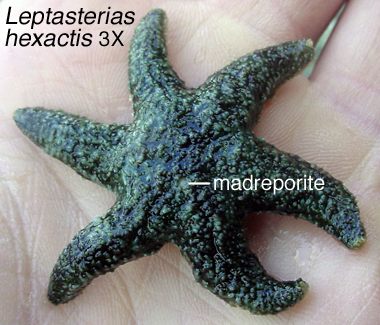

Fig. 1.  Location of madreporite on Leptasterias hexactis
Courtesy Dave Cowles, Walla Walla University, Washington

Fig. 2.  Details of aboral skin features of Leptasterias hexactis
Courtesy Dave Cowles, Walla Walla University, Washington

After bathing Leptasterias hexactis in seawater containing fluorescent microbeads (0.2µm dia) for 48h, high concentrations of beads are found in the lumen and lining of the tube feet, the ampullae, and within the Tiedemann’s bodies. The route taken is from madreporite (Figs. 1 - 2) to stone canal, then radially outwards to ampullae and tube feet. The flow rate is small (2 - 3 µl per g animal per h) but, as noted in Research Study 1 above, is considered by the authors necessary for sustaining the volume of the perivisceral coelomic fluid.  Detailed studies on the fine structure of madreporites and stone canals in sea stars suggest that the madreporite is not just a simple sieve-like entrance to the water-vascular system; rather, it has abundant secretory cells, phagocytic coelomocytes, and an extensive complex of nerves. The authors conjecture that the madreporite may utilise the strong ciliary pumping of the stone canal to cleanse coelomic fluids drawn in from the axial sinus, as well as seawater from outside, and could possibly be a route for pheromone-like substances to reach internal parts and trigger reproductive activities or other functions. The exact way that this might work is not known, and these ideas are highly conjectural, but nonetheless provocative.

NOTE  this is part of the so-called hemal system, lying alongside the stone canal and joining the aboral hemal ring to the oral hemal ring.  All parts of the hemal system are coelomic 

Ferguson   1990   J Exp Zool 255: 262
Ferguson & Walker   1991   J Morphol 210: 1

Research Study 3
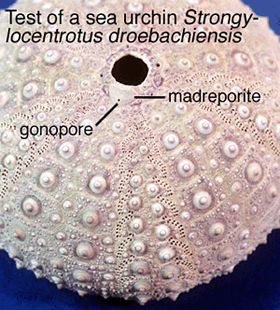
Fig. 1.  Test of green urchin Strongylocentrotus droebachiensis showing location of madreporite.  Note that the madreporite is perforated by the duct from one set of gonads and bears the corresponding gonopore. The other four gonopores are visible. The large opening in a living animal is covered by the fleshy periproct with the anus in its centre, not visible in this cleaned specimen
Fig. 2.  Madreporite and associated structures in Strongylocentrotus droebachiensis

Just for comparison, the madreporite of sea urchins Strongylocentrotus droebachiensis consists of 300 - 400 pore canals lined with cilia (Fig. 1).  However, the pores are so small that, in total, they represent only about 0.1mm2.  Studies at Friday Harbor Laboratories, Washington using fluorescent microbeads (0.2µm dia) placed for 5d around these openings show inward movement of fluid at an estimated rate of 0.1ml per day for a 200g animal.  Most of the beads are caught up within the stone canal (Fig. 2), but a few make it as far as the tube feet. Is this enough of a flow rate to be functionally significant?  By blocking the madreporite with cement, the author is able to show a significant decrease in mass over 27d and credits this to less food being present in the gut. While diminished feeding could result from gradual loss of tube-feet activity through decrease in volume of the water-vascular system, as suggested by the author, could it also possibly be an effect of scraping and plugging treatment itself, especially if the madreporite functions in ways other than water-volume regulation. 

Ferguson   1996   Biol Bull 191: 431