Research Study 1

Fig. 1. Ochre star Pisaster ochraceus anchored to a rock with its tube feet during low-tide exposure. The attachment is so stong that the the tube feet are often ripped off when force is applied to the body, leaving the torn-off portions hanging onto the rock
How do the tube feet attach to the substratum (Fig. 1)? Early thoughts were that suction is created by special levator muscles raising up the centre of the terminal disc of the sucker in combination with secretion of sticky mucus, but focus is now mainly on chemical adhesion by fast-acting glues. Microscopic examination of tube-foot epithelium of Leptasterias spp. reveals three types of cells: adhesive, large-granule secretory, and monociliated ones thought to be sensory in function. A sea star moving across a clean surface, like glass, actually leaves tube-foot prints, marks left by secretions. A sea star attaching and detaching to surfaces naturally filmed with bacteria and diatoms invariably has clean tube feet, indicating that adherent material does not accumulate on the tube-foot surfaces. Nor do the tube feet stick to, or pull on, the coated substratum as they are lifted away. The authors remark that through the nature of proteinaceous secretions from the adhesive and large-granule secreting cells the entire surface of the sucker end of the tube foot becomes negatively charged. This may also be involved in attachment to the substratum. Tube feet attach best to charged substrata like rocks, plastic, metal, and so on, and attach poorly or not at all to uncharged surfaces such as Parafilm, dental wax, epoxy resin, and so on. Detachment may be effected by secretion of other chemicals, releasing the tube feet cleanly from substrata to which they have attached, but leaving footprint residues behind. From the results of their study, the authors do not discount the involvement of suction, especially on solid surfaces, but suggest that this is a secondary adjunct to adhesion established by protein glue.
NOTE although the authors state that the “distal surface of the tube foot is coated by a negatively charged surface which somehow attaches to the substrata”, the way that this might work is not made clear. Perhaps it will be the subject of a future study
Thomas & Hermans 1985 Biol Bull 169: 675
Research Study 2
We usually assume that sea stars either have Pointed Non-Suckered tube feet (categorized as PNS in this article) useful in mud-bottom habitats as in Luidia spp. in the Order Paxillosida, or they had Flat-tipped Suckered tube feet (FS; Figs. 1, 3, 6) useful in hard-bottom habitats, as in Pisaster spp. in the Order Forcipulatida. A study by researchers at the University of Alabama, however, shows that this simple notion needs to be reconsidered, as there is considerably greater variation in tube-foot morphology in asteroids than previously thought. The authors examine 45 world species in 7 orders and 19 families, with 16 west-coast species being included. Their observations require the creation of four new categories of tube-foot morphology, including Semi-Pointed Non-Suckered (SPNS), Flat-tipped Non-Suckered (FNS), Semi-Flat-tipped Suckered (SFS; Fig. 4), and Semi-Flat-tipped Non-Suckered (SFNS; Fig. 5). The authors also find that a consistent relationship exists between tube-foot morphology and taxonomic order. Thus, all Forcipulatids have Flat-tipped Suckered tube feet (FS), all Velatida have Semi-Flat-tipped Suckered ones (SFS), all Valvatida have Flat-tipped Non-Suckered ones (FNS; Fig. 2), and so on. Notwithstanding this taxonomic consistency, the authors remark on the variability in tube-foot morphology in asteroids and suggest that what is needed now is a better idea of how each morphology suits a particular locomotory, feeding, and anchoring need.
NOTE this could be a tall order. The taxonomic affinities noted by the authors are certainly interesting, but now we're faced with the universal "lumper/splitter" quandary, that is, which one do we like? This will be something that can only be resolved after seeing how popular these new ideas are with other "asteroidiphiles"
The following photographs (Figs. 1 - 6) illustrate a few of these tube-foot morphologies:
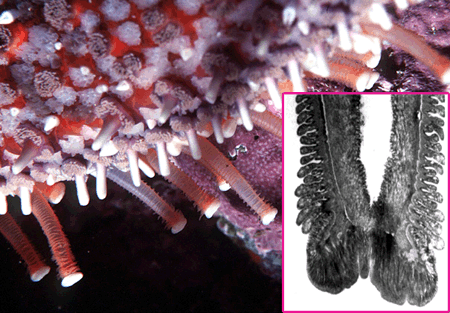
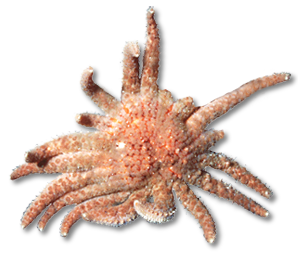
Fig. 1. Sunflower star Pycnopodia helianthoides: Order Forcipulatida: Flat-tipped Suckered FS

Fig. 2. Bat star Patiria miniata Order Valvatida: Flat-tipped Non-suckered FNS

Fig. 3. Pink star Pisaster brevispinus: Order Forcipulatida: Flat-tipped Suckered FS

Fig. 4. Slime star Pteraster tesselatus: Order Velatida: Semi-Flat-tipped Suckered SFS

Fig. 5. Sea star Luidia foliolatum: Order Paxillosida: Pointed Non-Suckered PNS. This species inhabits sandy habitats and tends to walk "tippy-toe" over the substratum

Fig. 6. Blood star
Henricia pumila: Order Spinulosida: Flat-tipped Suckered
FS. The suckers are hard to see in this photo as they are pulled into the ambulacral groove, and further protected by spines
Courtesy Dave Cowles Walla Walla University, Washington
Vickery & McClintock 2000 Amer Zool 40: 355
Research Study 3

Fig. 1. Scanning e-micrographs of a rough-surfaced plastic sheet at three different magnifications, shown with corresponding disc morphologies of Asterias-rubens tube feet attached to the sheet
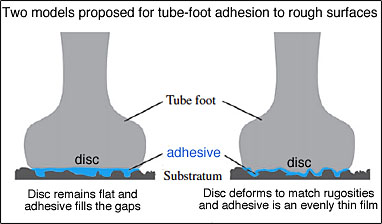
Fig. 2. Of the two options proposed for adhesion of tube feet of Asterias rubens, the authors favour the one on the Right.
As no comparable studies seem to have been done on west-coast asteroids on this next topic, we turn to Belgian and German researchers to learn how chemical adhesion is augmented by physical deformation of the tube-foot sucker surface in the common European sea star1 Asterias rubens. Firstly, the sucker is soft and adapts in microdimension to substratum2 irregularities, thus greatly increasing attachment strength (Fig. 13). In this way and owing to the increase in geometrical area of disc contacting the substratum, tenacity increases with roughness. The authors theorise that at the moment of contact, the disc tissue viscously adapts to the surface rugosity, leaving the adhesive material to fill in only the most minute surface irregularities (Fig. 2). These spaces are in the nanometer range. The epidermis of the disc contains two types of adhesive cells, one type secreting the adhesive; the other, a de-adhesive. During fast locomotion these two processes occur very quickly. The researchers further theorise that, when the sea star is anchored and not moving, the disc surfaces behave elastically during short-duration wave-impacts and other disturbances to distribute stress evenly along the entire disc surface. This minimises peeling and risk of tube-foot detachment.
NOTE1 the authors also include a representative sea urchin in their study, not dealt with here
NOTE2 in this case, rough-surfaced polymethyl-methacrylate plastic sheeting
NOTE3 there seems to be problems in the magnifications indicated in the Fig. 1 photos. For example, the image bottom-Left is indicated by the scale bars to be only about 50% greater magnification than the image above, but the apparent magnification seems to be much greater. More problematical still is the image bottom-Right that appears by the scale bars to be about 35% larger than the two images above it, yet why doesn't the tube-foot diameter reflect this? In the authors' defense, they do acknowledge that their work is not "rocket science", as there is much individual variability in tube-foot shape and degree of deformation
Santos et al. 2005 J Exp Biol 208: 2555
 Sea stars