Research Study 1

Fig. 1. Bat stars
Patiria miniata, of the 5-armed variety
Courtesy Kevin Lee, Fullerton CA

Fig. 2. 6-armed
Patiria miniata from Moss Beach, CA
Courtesy Ron Wolf, CA
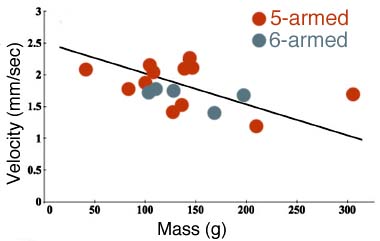
Fig. 3. Predator scent-induced crawling velocities of different-sized 5- and 6-armed bat stars Patiria miniata
Researchers at the Bamfield Marine Science Centre, British Columbia investigate effect of body size on locomotion in bat stars Patiria miniata (Fig. 1). Response speeds of crawling by test animals are "standardised" by stimulating them with a squirt of water from aquarium tanks containing Solaster dawsoni, a known predator of asteroids including bat stars. As bat stars can be found with variable arm numbers, the effect of arm number is also tested using 5- and 6-armed (Fig. 2) individuals. Results for the first part of the study, body size, are contrary to that expected from scaling predictions and from what has been shown for sea stars in other studies. Fig. 3 shows a good fit of body-size data to crawling velocity. The explanation for the negative slope of the regression line is discussed by the authors, but remains unclear. The data also show that number of arms appears not significantly to affect velocity, as could be expected based on how a sea star locomotes. Thus, single steps by the tube feet on one arm must be matched by those on all other arms, lest one part of the body lag behind or speed ahead which might cause an individual to crawl erratically. Addition of a 6th arm therefore should not measurably affect crawling speed. Predator-escape velocities from adult-sized aimals at rest generally plateaued after 100sec or-so at a velocity of about 1 - 2mm per sec whether 5- or 6-armed.
NOTE perusal of several hundred Google images of bat stars reveals that 6-armed individuals are rare, perhaps representing less than 3% of the total. As for bat stars, anecdotal reference to variable numbers of arms, up to 9, has been made by another author but, as an avid bird-watcher would say, "where's the skin?!"...or photograph, in this instance
Montgomery & Palmer 2012 Biol Bull 222 (3): 222
Research Study 2

Fig. 1. Body size and locomotory speed relationships in asteroids Pycnopodia helianthoides, Solaster stimpsoni, and Dermasterias imbricata. Note that scaling relationships for the two multi-armed species are as predicted, but not for the leather star Dermlasterias imbricata
In a follow-up study at the Bamfield Marine Sciences Centre one of the above researchers investigates in more detail the relationship between body size and locomotory speed in three species of west-coast asteroids Pycnopodia helianthoides, Solaster stimpsoni, and Dermasterias imbricata. Although larger individuals within a species are generally expected to crawl more quickly than smaller ones, for the seastars tested here this holds true for only the sunflower star Pycnopodia helianthoides and the sun star Solaster stimpsoni; the third species tested, the leather star Dermasterias imbicata, actually crawls more slowly as size increases (Fig. 1; all slopes are statistically significant). As locomotory speed in asteroids depends, in part, upon tube-foot length, an increase in body size should lead to longer tube feet and thus to an increase in step length. This could explain the results for Pycnopodia and Solaster, but not Dermasterias. A major difference between the three species is that while both Pycnopodia and Solaster add arms as they age, Dermasterias does not. The author states that increased podia numbers would increase crawling ability, but this is likely not true for two reasons. First, a single step’s forward progress for a seastar requires that all tube feet in contact with the substratum make the same length of step; otherwise some tube feet would be dragging (as happens when certain species, such as P. helianthoides, are moving quickly). More tube feet would increase attachment strength, but not necessarily locomotory speed. Second, is it possible that a greater density of tube feet might actually decrease “crawling ability” because of increased interference between them? The study is an interesting one, and provides much to think about.
NOTE locomotory speed in a seastar will be a factor of both step length and step frequency of the tube feet
NOTE the author weakens the discussion by using several inappropriate teleologies as, for example, “The reinforced disc morphology is designed for both locomotion and attachment”. Additionally, there is some duplication of graphs from the author's 2012 paper without appropriate referencing acknowledgment
Montgomery 2014 J Exper Mar Biol & Ecol 458: 27
 Sea stars