Research Study 1
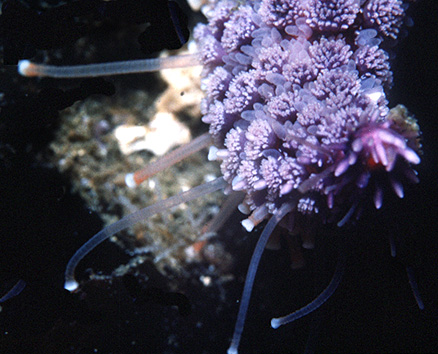
Fig. 1. Arm tip of a sunflower star Pycnopodia heliathoides showing the red eyespot nestled within a protective array of spines (at 3 o'clock position). Other features to note are the long, chemotactile tube feet, clusters of pedicellariae, and the sac-like dermal branchiae (gas-exchange organs)
Many species of sea stars curl up the tips of their arms when crawling, as shown here for an arm of a sunflower star Pycnopodia helianthoides (Fig. 1). The behaviour can also be induced by a variety of mechanical, chemical, and photic stimuli. Not only does the behaviour provide maximum exposure for sensory tube feet located at the arm tips, but the light-sensitive eye is also exposed.
NOTE also known as the compound ocellus or optical cushion. Information on light effects on the morphology and physiology of ocelli of Patiria miniata, Leptasterias pusilla, and Henricia leviuscula can be found in Eakin & Brandenburger (1979)
Sloan 1980 J Nat Hist 14: 469
Eakin & Brandenburger 1979 Zoomorph 92: 191
Research Study 2
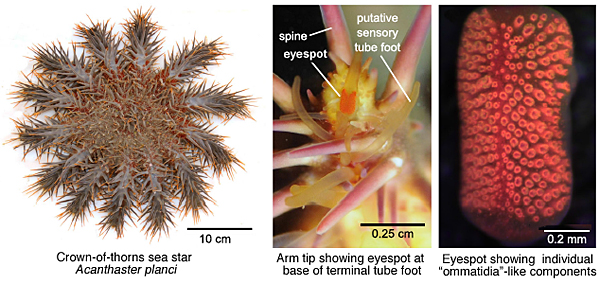
Fig. 1. Crown-of-thorns sea star Acanthaster planci, showing arm tip and eyespot, and a magnifieid view of the eyespot

Fig. 2. And what might Acanthaster planci “see”? Based upon estimates of nervous- system function, sensitivity to blue wavelengths in the eyespots, and extent of overlap of the visual fields of the eyespots, the authors suggest that light-dark resolution might be as shown here in simulated Gaussian-blur format (lower image in each pair). The two views show a coral outcropping on the Left and an opposing open-ocean view on the Right. The lower photographs are simulations of what Acanthaster might perceive. The process by which the sea star makes the "decision" as to which direction to crawl is likely to be a major study in itself
If the west-coast geographical limits of the ODYSSEY are expanded southward to include the Pacific coast of Costa Rica, then a fascinating study done by researchers from the University of Copenhagen and Australian Institute of Marine Science on function of eyespots in the crown-of-thorns seastar Acanthaster planci1 (Fig. 1) can be included. The eyespots² are more complex than those of other species, each consisting of about 250 red-pigmented “ommatidia”-like light-receptive units arranged in bilateral clusters at each arm tip . The eyespots develop on specialised terminal tube feet. Electrophysiological measurements indicate that peak sensitivity of the light-absorbing pigment is in the blue part of the visual spectrum (470nm), a wavelength that penetrates readily through seawater. The authors determine that the field of “view” from any eyespot is a slot 100° wide by 30° high, and the overlapping visual fields of the eyespots appear to provide a degree of spatial resolution around the animal’s circumference, useful enough for distinguishing dark areas of coral from open areas (Fig. 2 ). The sensitivity or flicker-fusion frequency (FFF³)of the system is exceedingly low (0.6 • sec-1), the lowest yet measured for any animal, but commensurate with the sea-star’s relatively slow locomotion and low image-resolving capability. Field experiments comparing behaviour of normal and blinded4 individuals around patch reefs show that individuals with intact light perception in daylight will move towards the reefs, while blinded individuals will move in random directions. The study is a provocative insight into the sensory world of sea stars, and the authors are to be congratulated.
NOTE¹ while most abundant in Indo-Pacific waters, A. planci’s distribution extends to the west coasts of Costa Rica and Panama. Specimens used in the study are flown in from Indonesia and Australia to laboratory research facilities in Copenhagen. Field studies are done on reefs near Cairns, Australia
NOTE² the authors refer to the pigmented units as “eyes” and “ommatidia”, but this is a bit of a stretch. No lenses, no retinas, and no focussing abilities exist in the eyespots. The nervous system is simple and lacking any sort of ganglia to integrate sensory input. So, resolved images appear to be neither formed, nor integrated other than crudely
NOTE³ flicker-fusion frequency or FFF is a measure of the “quickness” of visual response, expressed in Hertz (Hz = “per second”). Values are 60 for humans, 70 for octopuses, 80 for dogs, 120 for fast-moving semiterrestrial isopods, and 300 for bees and flies. For humans, image resolution becomes, well, flickery for any TV broadcase < 60 Hertz. For more on FFF see ISOPODS>PREDATORS & DEFENSES>EXOSKELETON & FAST RUNNING
NOTE4 the eyespot clusters develop at the base of a single, unpaired tube foot at the tip of each arm, so to blind an animal one has only to remove this terminal tube foot from each arm. In the blind/“sighted” field experiments the authors create a “sham” experimental treatment in which two locomotory tube feet are removed from the middle of each arm. As expected, all sham-treated individuals behave apparently normally
Petie et al. 2016 Coral Reefs 35: 1139
 Sea stars