Research Study 1

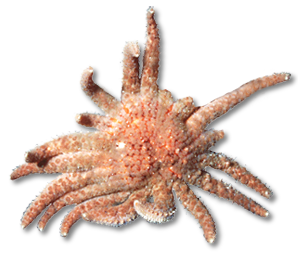
Fig. 1. Three west-coast species Pycnopodia helianthoides, Solaster dawsoni, and Crossaster papposus shown in both diagrammatic (oral view) and photographic (aboral) views. In all three species, metamorphosis leads to initial formation of five arms (A - E), with other arms being added later, pair-wise. Note that the diagrams and photos are mirror images of one another because the first is an oral view and the second, an aboral view. Note also that the photos are arranged with the madreporite ("mad") in the same relative position for each species, and that later addition of arms differs in location for each species (small black arrows). Note also in the photographic view for Pycnopodia that the arrow designation on the Right is incorrect...it should be one arm farther up the photo, between arms D and 7, not between arms 6 & 7
What about number of arms with respect to locomotion? This seems fundamental to any consideration of moving in sea stars, yet only rarely is the condition of multi-rays (multiradiate) even considered in textbooks from an evolutionary standpoint, let alone from a standpoints of efficacy in locomotion, or feeding, or whatever. The evolutionary aspect is considered in a scholarly article by Prof. F.H.C Hotchkiss, Harvard, Mass., long a student of “armedness” in asteroids and other echinoderms. The article deals broadly with world representatives of the group, but includes several west-coast asteroids. Of 34 asteroid families in the world, 20 are strictly five-rayed, while the remaining 14 have multiple rays (9 of the 14 have both five- and multi-rayed species). Thus, only five families are exclusively multiradiate. The professor considers several ideas for the origin of the multiradiate condition. Basically, in five-armed families the five “primary” rays develop as a unit (known as en bloc pathway), and this pattern remains intact through metamorphosis (Fig. 1). One idea for multiradiate families is that the en bloc condition holds for only a brief time during development, then so-called supernumerary rays develop. Another idea proposes that the “primary-arms en bloc-pathway” has no heritable variation and cannot be “co-opted” for the production of extra arms. However, according to the Professor, the timing and pattern of development of the extra rays in the different families is actually so variable as to suggest recurrent multiple origins in the evolution of multiradiate sea stars.
NOTE rays or arms? Either is good. The first is more commonly used in the UK and areas of the east coast of North America, while the second is used most anywhere
NOTE an interesting side-remark in the paper is that selective breeding for aberrant arm number is unsuccessful, as only five-armed offspring are produced. Thus, genetic control of “aberrant” arm number seems to be ruled out (is this llikely, do you think?)
Hotchkiss 2000 Am Zool 40: 340
 Sea stars