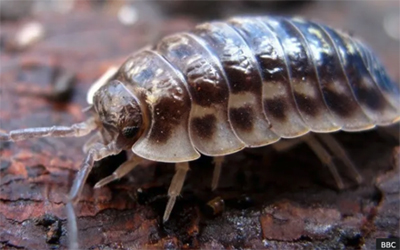
Fig. 1. Woodlouse Oniscus asellus, found commonly in gardens. Its distribution is limited to moist conditions out of the sun
Of all present-day terrestrial invertebrates, only crustaceans are thought to have invaded land directly over sea beaches. All other terrestrial invertebrates, including worms, insects, spiders, and flatworms, and all vertebrates, are believed to have evolved onto land via freshwater. Of crustaceans, only oniscidean isopods and a few amphipods have successfully colonised land. There are many species of semiterrestrial crabs, but only a few terrestrial ones. This owes, in the main, to the need for females to be within walking distance of the ocean to release their larvae for pelagic development. Semiterrestrial and terrestrial isopods are found in the Suborder Oniscidea (Figs. 1 - 3).
NOTE one species of crab in Jamaica eliminates the need for this by incubating its larvae in water trapped in the leaf-bases of large bromiliad plants; other tropical species either walk to the ocean to release their larvae, or release them into small streams as in some Hawai'ian species that, within moments, carry the otherwise freshwater-intolerant larvae to the ocean
NOTE researchers interested in studying Oniscidean isopods are found the world over, but perhaps not in the numbers present in Europe. In 1983 a group of scientists met for the first time in London for a symposium on the biology of terrestrial isopods sponsored by the Zoological Society of London. It was a unique gathering, united by a common interest in woodlice, and it generated many new research collaborations, a symposium volume, and led to a series of meetings held later in Italy (2nd: 1987), France (3rd: 1990), Israel (4th: 1997), Greece (5th: 2001), Portugal (6th: 2004), Tunisia (7th: 2007), Slovenia (8th: 2011, France (9th: 2014), Hungary (10th: 2017, Belgium (11th: 2021), and Czech Republic (12th: 2023/24?), each meeting producing its own symposium volume
To learn about evolution of isopods to land, select a topic from the menu above.
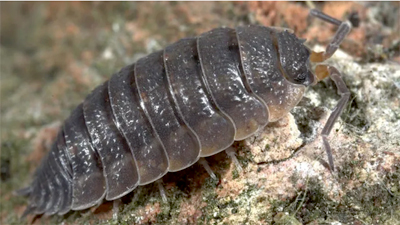
Fig. 2. Rollypolly isopod Armadillidium vulgare, so named because it can roll into a near-perfect ball when disturbed. Members of the genus are well-adapted for life on land, and inhabit drier locations than most other oniscideans
Courtesy BBC, London
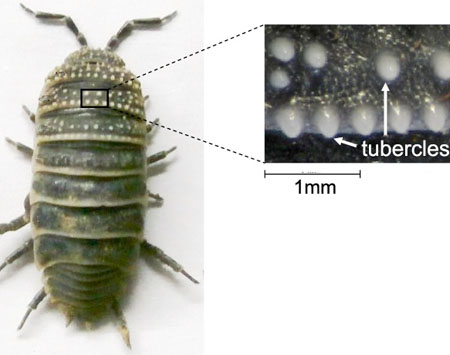
Fig. 3. Desert isopod Hemilepistus reaumeri (2cm body length), arguably the oniscidean species most well-adapted to life on land, even to inhabiting burrows in places like the Negev Desert. Males are monogamous, and share a burrow with a single female and eventually a single brood of isopod juveniles. Under certain circumstances the whole lot of them will emerge from their burrow and march off to a new area. The species has many adaptations for land life, including an extra-thick cuticle armed with protective tubercles, and an ability to take up water vapour from the air (Ayari et al. 2016)
Courtesy the authors
Ayari et al. 2016 J Struct Biol 193 (2):115
 Isopods