 Isopods
 Research Study 1
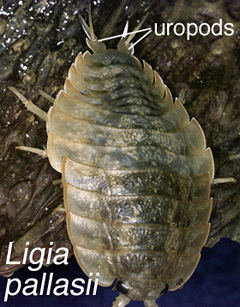
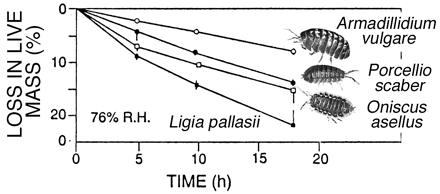
A study on four oniscid species in British Columbia, including the semiterrestrial Ligia pallasii, shows that overall resistance to drying at 76% RH follows the order L. pallasii < Oniscus asellus < Porcellio scaber < Armadillidium vulgare, which corresponds with the degree of exoskeleton permeability and matches the accepted order of increasing terrestriality (Fig. 1). Providing that losses are less than about 25% over a period of a few hours, all species rehydrate quickly when returned to moist conditions. During feeding and other excursions Ligia pallasii commonly dips its uropods or last pair of appendages into puddles, with the tips pressed together (Fig. 2). The water is conducted by capillary action along the juxtaposed appendages into the gas-exchange areas and into the brood chambers of females.
Research Study 2
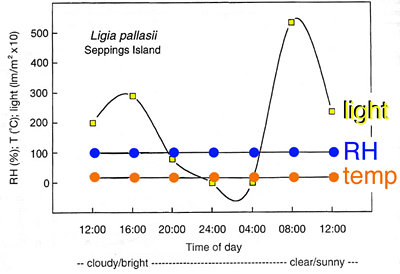
The sea slater Ligia pallasii in British Columbia occupies supralittoral rock-crevice or tumbled-rock habitats extending vertically only 1 - 2m above the high-water mark. At one boulder/cobble site in Barkley Sound (Seppings Island) in situ
Research Study 3
Isopods (and all crustaceans) rely mainly on the release of ammonia to rid the body of nitrogenous wastes. However, whereas for marine isopods and other crustaceans this is in the form of ammonium ion NH4+, which is highly soluble in water, for all semiterrestrial and terrestrial isopods it is in the form of ammonia gas NH3, which requires no water for release. In the semiterrestrial Ligia pallasii, over 90% of total nitrogenous waste is eliminated via ammonia gas. The exact means of release is not known, but release along with urine from the paired maxillary glands on either side of the mouth is commonly suspected. This unique excretory mode appears to be an evolutionary compromise. Retention of ammoniotely via release of gaseous ammonia allows Ligia and terrestrial species to conserve energy, as it is a much less
Dresel & Moyle 1950 J Exp Biol 27: 210