
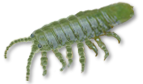
Fig. 1. Large male
Ligia pallasii in copulatory amplexus with a female, who is just visible under the male's Right carapace edge
Courtesy Jackie Soanes, Bodega Marine Laboratory, California
Recent molecular investigation of isopod evolution by a researcher at Wellcome Sanger Institute, Cambridge UK points to a single origin of terrestriality in isopods. The estimated date of this is 105mya, obviously concurrent with the origin of the entire Oniscidea group of land-dwelling isopods. The Ligiidae group, including Ligia spp., is one type of ancestral littoral group nominated as a progenitor type (Thomas Thorpe, 2024).
Few taxonomic groups provide a richer example of evolution than terrestrial isopods in the Suborder Oniscidea. Oniscideans represent a highly successful terrestrial-colonising group of some 4000 species inhabiting seashores, forest, savannahs, and deserts. Common semiterrestrial members of the group are Ligia spp. known as sea slaters or rock lice, while terrestrial members are known as sow bugs, woodlice, wood bugs, and many other common names. Several examples of terrestrial Oniscideans are included in the Odyssey because they represent the largest group of crustaceans successfully to invade land, doing so directly over sea beaches. The remarkable adaptive radiation of oniscideans is exemplified by three European species Armadillium vulgare, Porcellainus scaber, and Oniscus acellus, which, by infesting outward bound luggage and cargo, and perhaps floating about the oceans on debris, have spread to many parts of the world, including the North American west coast. This radiation can provide after a short period searching of dock areas, house gardens, and under pots and abandoned wood, a selection of isopods showing a marvellous evolutionary gradation of body morphology, behaviour, and physiology. Either of two species of sea slater Ligia pallasii and L. occidentalis might be found in such a collection. These two species, along with about 48 other congenor world species, are known, although this list will likely be shortened as new molecular information comes available. Ligiids are interesting because their habit of life and morphological and physiological features accord with our views of what early evolutionary isopod land colonisers must have been like. Ligiids are evolutionarily close to their presumed marine ancestors, and several features of morphology, physiology, and behaviour are transitional between marine and fully terrestrial forms. So said, it is important to note that present day ligiids do not represent an ancestral stock that gave rise to more terrestrial forms; rather, all oniscideans are descended from a common Ligia-like ancestral stock. Ligia is not a group whose adaptational features stalled them at the semiterrestrial stage; rather, they represent a group whose adaptational successes have enabled them to thrive in a complex habitat that straddles sea and land. Features of evolutionary interest of ligiids and other terrestrial isopods include desiccation resistance, gas exchange, moulting, reproductive adaptations, and modifications in feeding and digestive processes, and these topics are considered here.
NOTE this name is specific to members of the genus which are mostly slate grey in colour. Other names for them are “boat bugs” (funemushi in Japanese, referring to their presence in docks and marinas, beached boats, and fishing equipment) or sea roaches/wharf roaches in Italy and elsewhere
NOTE people who know about such things report that common names for oniscidean isopods number in excess of 250, reflecting both their ubiquitous distribution in most or possibly all temperate countries, and perhaps also their appeal to children. Of all their unusual names cudworm might top the list, so named for a belief that feeding them to cows that have lost their cud will soon restore it
Alikhan 1995 In, Terrestrial Isopod Biol (Alikhan, ed.)
Carefoot 1993 Comp Biochem Physiol 106A: 413
Jessica Thomas Thorpe 2024 Proc. R. Soc. B 291: 20241042
 Isopods