 Nudibranchs & relatives
 Predators & Defenses
The topic of Nudibranchs & relatives: Predators & Defenses is covered in 14 sub-sections:
- CAMOUFLAGE (CRYPSIS)
- MUCOUS COATINGS
- CERATAL AUTOTOMY
- NUTRITIONAL CONTENT
- SPICULES
- NEMATOCYSTS
- VACUOLATED SKIN WITH PROTECTIVE SECRETIONS
- SECRETIONS: ACID
- SECRETIONS: INK & OPALINE
- SECONDARY METABOLITES
- ALARM PHEROMONES
- WARNING COLORATION & BATESIAN MIMICRY
- NAVANAX: SPECIAL CASE STUDY
- ESCAPE BY LOCOMOTION

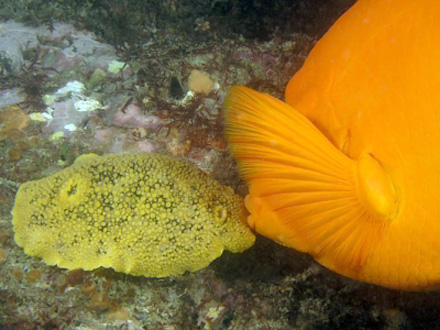
As can be seen from the above list, the defensive repertoire of nudibranchs and their relatives (Opisthobranchia) is extremely strong, and is unmatched in scope by any other marine invertebrate taxon. In face of such defenses, it is not surprising that predators are scarce or absent. Examples of supposed predation are described below.
Two researchers from Pacific Union College, California witnessed a nudibranch Peltodoris nobilis apparently being consumed by an anemone Anthopleura artemisia (Fig. 1). The authors did not see the outcome, but the interaction is interesting nonetheless. A second example of "predation" on Peltodoris nobilis, in this case by a garibaldi fish Hypsypops rubicundus. is shown in Fig. 2. Predation on nudibranchs is so unusual as to be essentially non-existent, likely owing to their impressive defenses. So, it is quite likely that what we see here are simply happenstance and not examples of an evolved predator-prey relationship.