Research Study 1
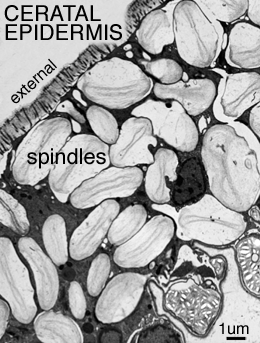
Fig. 1. Spindle-protected skin of aeolid nudibranch Flabelliina sp.

Fig. 2. Skin of plant-sucking sacoglossan Elysia viridis has only mucus for protection
What protection, if any, do nudibranchs or other opisthobranchs have from being stung by nematocysts of their prey, either during feeding or as they brush against them? A recent study on several nudibranchs in Europe is germane to this question, especially since some of the genera considered in the study are represented by congenors on the west coast of North America. Briefly, the authors describe the presence in aeolids that feed on cnidarians of large ovoid discs, called spindles, in epidermal cells of regions exposed to nematocysts, such as the certata, lips, rhinophores, and gas-exchange surfaces, as well as in the stomach linings (e-micrograph, Fig. 1, shows one or two ceratal cells in the epidermis of Flabellina sp.). In contrast, in sponge- and bryozoan-eating dorids, glandular cells predominate. Spindles and vesicle cells are absent as well in plant-sucking sacoglossans. Their epithelial surfaces are thin and contain abundant glands for mucus production (Fig. 2, skin of the sacoglossan Elysia viridis). The abundance of spindles in epithelia of aeolids which are most exposed to nematocyst discharge by the prey, and the apparent insulating nature of these cushion-like entities, strongly suggest a protective role. The authors propose a dual defensive strategy in nudibranchs. On the one hand, there is glandular production of mucous coats and aversive secretions (defensive chemicals) as in dorids and, on the other hand, the presence of structural defensive devices that are like cushions stuffed with inert grains, as in aeolids.
NOTE the spindles occur in large vesicles and appear in scanning e-microscopical view to be biconcave discs about 5µm along the long axis, with thick rims, and filled with a meshwork of polysaccharide filaments. The vesicles (or “vacuoles” or “balloon-like structures”) and their contents have been described many times since the end of the 19th Century, but in a haphazard way, and the value of the present work is in its comparative approach using representatives of different nudibranchs and sacoglossans
NOTE in a complementary paper, done at the same time and by the same research group in Italy and Germany, the composition of the intracellular grains (granules or spindles) is confirmed to be chitin. In contrast to the inflexible protective coating of chitin as found in arthropods, however, a nudibranch's "suit of armor" does not interfere with the skin's suppleness and flexibility (Martin et al., 2007)
Martin et al. 2007 Mar Biol 150: 807
Martin et al. 2007 Biol Bull 213: 307
Research Study 2

Fig. 1. Proposed operation of protective spindles in an aeolid nudibranch such as Flabellina sp.
The way in which the spindles might work to neutralise nematocysts discharging into the skin of a nudibranch such as Flabellina sp. is described in an earlier paper by the same research group. Upon impact of discharging nematocysts, muscles beneath the basal lamina of the epithelium of the aeolid contract, and this causes the basal lamina to fold. The folding compresses the epidermal cells, causing them to rupture and release spindles. The spindles stick to the nematocysts, interfere with their penetration and “stickiness”, and cause the nematocyst threads to release their attachment to the nudibranch’s skin.
Martin & Walther 2003 Zoomorph 122: 25
 Nudibranchs & relatives