Research Study 1

Fig. 1. Settlement of Balanus glandula larvae in relation to space available

Fig. 2. Survival of Balanus glandula recruits in areas populated with sea stars Pisaster ochraceus favours less densely settled areas

Fig. 3. Hummock of barnacles Balanus glandula created by competition for space. Part of the hummock has been removed, possibly by sea stars Pisaster ochraceus or by floating debris in the waves
Although it seems obvious that the rate of settlement of barnacles Balanus glandula onto an area of rock surface will be proportional to the fraction of vacant space available (Fig. 1), how variations in settlement rate later affect the kinetics of the intertidal community assemblage is not so obvious. In fact, studies in Monterey Bay, California suggest that settlement variability appears to play as important a role in structuring the community as post-settlement processes such as predation and competition. In areas where barnacle settlement is low, population density varies from year-to-year, but usually in direct accordance with yearly differences in setlement. In such locations mortality, as from sea-star predation, is independent of the area occupied by barnacles. In areas where barnacle settlement is high, however, population density varies greatly within years, but only slightly between years, regardless of yearly differences in settlement. In these densely occupied locations mortality becomes cover-dependent owing to increased predation by sea stars Pisaster ochraceus. The sea stars are more attracted to the areas with greater density of barnacles and, when they get there, their feeding efficiency goes up because they can eat clusters of barnacles a a time rather than single individuals (Fig. 2). This is evidenced in the graph by the fact that all points indicating less than 0.8 survivorship are associated with discrete patches of basal plates characteristic of Pisaster predation. Additionally, where excessive crowding leads to the formation of hummocks (Fig 3), mortality goes up through removal of the hummocks by waves and log-battering. The importance of competition for space as a determinant of community structure as, for example, between species of Balanus and Chthamalus, may also apply mainly to locations with high settlement rates.
NOTE from their population models the authors credit these within-year oscillations in abundance, each with a period of 30wk, to time-lags based on growth. The authors describe the cycling process as commencing with heavy settlement onto spaces typically cleared by Pisaster, followed by rapid growth, and then a recurrence of sea-star predation.
NOTE think of an area “swamped” by potential settlers each year, where most or all of the available space is regularly filled
Gaines & Roughgarden 1985 Proc Natl Acad Sci 82: 3707
Research Study 2

Fig. 1. Thatched barnacles Semibalanus cariosus living in partial isolation
An obvious feature of barnacle assemblages Semibalanus cariosus (Fig. 1) in areas of the San Juan Islands, Washington during the early 1980s was the presence of a cohort of older, larger (> 20mm diameter) individuals. By studying photographic records dating back a decade, researchers could trace this cohort to an exceptionally good year for survival of Semibalanus in 1970. This followed an unusual spell of sub-zero temperatures coincidental with low spring tides that led to massive mortality of predatory whelks Nucella spp. in 1969 - 70. This mortality enabled more of the spring 1970 settlement of Semibalanus to reach size refuge (10 - 14mm diameter) before the whelk population recovered 1 - 2yr later. The single mortality event structured S. cariosus populations for more than a decade.

Fig. 2. The cohort of Semibalanus cariosus in question settled in 1970 and could be followed for the next 10yr or so (blue bars in histograms)
Sebens & Lewis 1985 J Exp Mar Biol Ecol 87: 5
Research Study 3

Fig. 1. Adult thatched barnacles Semibalanus cariosus with a predatory snail Nucella ostrina and several other species of barnacle recruits, photographed in southern British Columbia. In Alaska the ecological equivalent of this more southern whelk species is likely to be N. lima
The role that recruitment plays in population dynamics of barnacles in south-central Alaska is investigated for Semibalanus cariosus1 (Fig. 1) by a researcher at the Institute of Marine Science, Fairbanks. The question addressed is classic ecology, an attempt to determine the relationship between recruitment success and later adult population density, but has the additional interest of being conducted close to the geographic northern limit2 (Kachemak Bay) of a species. Results over a 3yr period show considerable yearly and between-site variability in recruitment3 success, part of the variability owing to different levels of predation. However, in only one year is initial larval settlement linearly correlated with subsequent adult density; in the other years recruitment greatly exceeds the capacity of the habitat to accommodate them. This leads to intense intraspecific competition for space. Interestingly, even during a low recruitment year there are ample recruits to maintain “normal” population density. The author suggests that even at its northern limit of distribution, recruitment of S. cariosus appears not to be the primary process limiting population numbers.
NOTE1 two other species Balanus glandula and B. balanoides are included in the study but, as both occur in far fewer numbers than S. cariosus and as their recruits could not, in any case, be differentiated in the field, they are not included here
NOTE2 ice scour north of 60o is apparently the most important determinant of northern distributions of barnacles in Alaska, but of course the extent of this influence may change depending upon changing patterns of global warming. The study site at Kachemak Bay, Alaska is at 59o35’N
NOTE3 the study uses both natural rock surfaces and plastic settlement plates, each type covered with predator-excluding mesh walls. These walls exclude larger predators such as whelks and sea stars, but not smaller ones such as limpets and nemerteans
Carroll 1996 J Exp Mar Biol Ecol 199: 285
Research Study 4

Fig. 1. Along-shore currents in Oregon promote settlement of species of intertidal invertebrates, while offshore currents in California generated by upwelling events act negatively on settlement

Fig. 2. Onshore recruitment of Balanus larvae in Oregon is much greater than in California (upper graph), while for Chthamalus there is no significant difference in extent of recruitment in the two areas
Recruitment sites for coastal marine invertebrates with pelagic larvae may initially depend upon vagaries of along-shore current flow including offshore movement of larvae in areas of upwelling. This is documented for a number of sessile species including acorn barnacles Balanus glandula and Chthamalus spp. by scientists at Stanford University. Detailed transect collections of these and other animals and seaweeds on shores of southern Oregon and northen California show that for some species such as Balanus glandula, distributions are much more dense in Oregon than in California. In the authors' opinion this may largely owe to alongshore currents in the former area favouring settlement of larvae from the plankton, while extensive offshore movement through upwelling in the latter area discourages larval settlement (Fig. 1). This also holds true for sea mussels and goose barnacles but, for as yet unknown reasons, not for seaweeds or acorn barnacles Chthamalus spp. (see Fig. 2 for barnacle data).
NOTE the two species Chthamalus dalli and C. fissus are notoriously difficult to differentiate on casual observation; hence, are combined here by the authors for convenience
NOTE significant difference between the two areas is shown for Balanus, but not for Chthamalus, although a trend is certainly apparent for the latter (Fig. 2)
Connolly & Roughgarden 1998 Amer Nat 151 (4): 311
Research Study 5

Fig. 1. Study locations at Sand Hill Bay and Hopkins Marine Station
What effect does variation in recruitment intensity of an integral successional stage in a rocky-shore community, such as a barnacle, have on later community structure? This familiar ecological question is addressed in Monterey Bay, California by manipulating densities of Balanus glandula and Chthamalus spp. in experimental plots at two locations. The locations, Sand Hill Bluff and Hopkins Marine Station are on either side of Monterey Bay, and have markedly different seawater temperatures and substratum types (Fig. 1). Note that in July 2000 water temperatures at Sand Hill Bluff on the north side of the Bay are considerably warmer than at Hopkins Marine Station on the south side. The authors’ research hypotheses are that variation in recruit density of barnacles will influence community composition through effects on competition for space or on facilitation. The first comes into play at high levels of recruitment and/or when space is limiting; the second, if space is not limiting. In the latter case, increased recruit density may actually lead to general increases in species abundances. In one of several experiments at the two sites the authors manipulate densities of Chthamalus in spring in replicate 8 x 10cm plots by first clearing the plots, applying crushed barnacles to enhance settlement of cyprids, then later culling recruits to densities of 200 per plot (high density) or 50 per plot (low density). The results are complex and are not presented here but, overall, the authors find no evidence that recruitment differences influence community composition through competition for space; rather, facilitation seems to be the more important process. The authors conclude that while differences in intensity of recruitment produce measurable changes in community composition, these changes may be short-lived.
NOTE in each location the upper intertidal area hosts only a few dominant motile organisms (two species of limpets, two species of predatory snails) and sessile organisms (two species of barnacles, up to three species of algae)
NOTE the presence of an early coloniser speeds up, or facilitates, establishment of a later coloniser
Forde & Raimondi 2004 J Exp Mar Biol Ecol 301: 1
Research Study 6

Fig. 1. Effect of cyprid size on recruit size in Balanus glandula
It is well documented that the health and vitality of a marine invertebrate larva will affect its growth and survival after settlement. This is confirmed for barnacles Balanus glandula in a combined laboratory and field study at the Oregon Institute of Marine Biology, Coos Bay. The researchers manipulate factors such as temperature and food ration1 during larval culture to produce cyprids of different sizes. Larger cyprids produce juveniles of larger size than smaller cyprids (Fig. 1). When transferred to the field the larger cyprids2 grow faster as juveniles and often survive better than smaller juveniles. By translocating3 naturally settled barnacles into the laboratory within 2d of settlement, the authors additionally find, not surprisingly, that initial juvenile size is a good predictor of juvenile growth performance later on. The authors note that the effects of larval nutrition may persist for some time in juveniles.
NOTE1 larvae and juveniles are fed diatoms Skeletonema costatum
NOTE2 these larger cyprids have more lipids and protein than smaller ones. Smaller juveniles are created by feeding larvae on reduced rations during the last naupliar stage
NOTE3 larvae are allowed to settle on 8 x 8cm slate plates drilled with arrays of small conical pits to induce settlement in the field
Emlet & Sadro 2006 Integr Comp Biol 46: 334
Research Study 7

Fig. 1. Coast of California showing location of Cape Mendocino at 40.4oN
In an exhaustive survey of genetic structure of 50 nearshore invertebrates along the west coast from California to Alaska researchers at Hopkins Marine Station, Pacific Grove find strong genetic structure in several species, including acorn barnacles Balanus glandula. Although sampling is limited to only four main areas along the coast, the genetic disjunction in this species appears to occur mainly around Cape Mendocino, California, a zone noted for genetic differentiation in other species (Fig. 1). That it occurs in Balanus and other species with broadly disseminating larvae is thought to owe to strong upwelling currents in the area of the Cape that tend to move water and contained nauplius larvae, in this case, offshore.
NOTE cytochrome-c-oxidaseI mtDNA
Kelly & Palumbi 2010 PLos One 5: e8594
Research Study 8
A related paper by researchers at the University of Georgia confirms the existence of the sharp genetic cline in Balanus glandula described in the foregoing Research Study. The main motivation for this later study appears to be in assessing whether possible temperature or other climate factors, such as relating to global warming, may be involved in maintaining the genetic cline. If so, expectation would predict a reduced presence of the more northern genotype in more southern areas. Although this has not happened, the authors do record lessened reproductive output at the southernmost distribution of the northern genetic lineage of Balanus.
Wares & Skoczen 2019 Biol Bull 236: 199
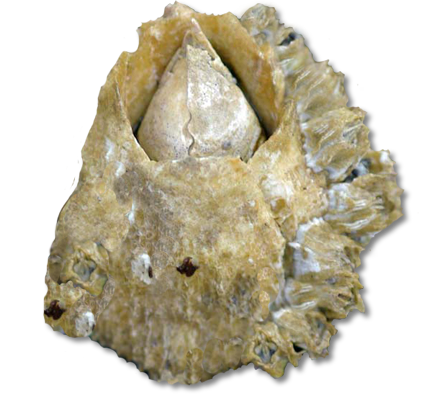 Acorn barnacles