Research Study 1

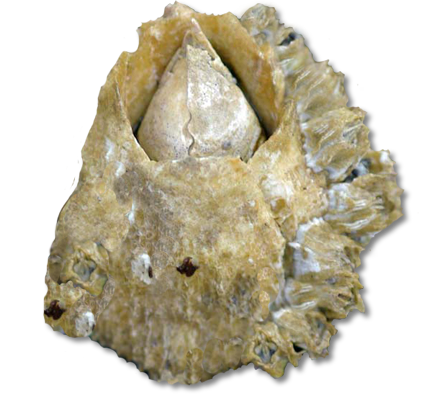
Fig. 1.
Megabalanus californicusCourtesy Kevin Lee, Fullerton, California
There is little published information on metamorphosis of barnacles in the west-coast scientific literature. However, a description of metamorphosis in Megabalanus californicus (Fig. 1) is provided by a researcher from the University of Vienna working at Scripps Institution of Oceanography, California. At 20oC in the laboratory, settlement by the cyprid larva is followed about 17h later by the first moult in which the bivalved carapace is shed. The body at this time can be divided into two halves, the posterior one representing the future barnacle body; the anterior one, representing a temporary stalk or peduncle (Fig. 2). The first moult takes only about 8min and involves a 90o rotation to bring the cyprid into an upright orientation. The new juvenile stretches and contracts to separate the carapace, which in a few moments drifts away. By this time the juvenile is supported on its peduncle and its motility is limited (Fig. 3). Over the next few hours primordial plates and several rows of cuticular hairs appear. The thorax now begins to rhythmically pump. By about 4h post-moult the peduncle flattens and becomes the base of the barnacle, the body shape becomes conical, and the juvenile is now sessile (Fig. 4). At about 6h post-moult the the rostrum, laterals, carina, and carinolateral plates grow in height and begin to calcify and become differentiated. The opercular plates (tergal and scutal) that protect the opening to the mantle cavity begin to calcify (Fig. 5). By this time the cirri have differentiated and are beating continuously. At about 12h post-moult the base is fully cemented to the substratum.
NOTE as nice as this photo series is, it is hard to see exactly what is going on. The presentation might have benefitted from inclusion by the author of diagrams, all from the same perspective and in the same orientation
NOTE the exact function of these hairs is uncertain. However, by their orientation towards and touching the substratum during post-moult body movements, the present author believes they may act to support the body to maintain its orientation during critical early cementation

Fig. 2. Photo series showing metamorphosis in Megabalanus californicus. Here, the recently settled cyprid prepares to cast off its bivalved carapace

Fig. 3. Appearance of mantle tissue, cyprid cement, and cuticular hairs in the newly metamorphosed juvenile Megabalanus californicus

Fig. 4. Five-hour post-moult Megabalanus californicus showing primordial tergal and scutal plates of the newly forming operculum

Fig. 5. Side view of 6h post-moult juvenile of Megabalanus californicus showing flattened, conical shape and four rows of cuticular hairs
Gusenbauer 2003 Master Degree Univ Vienna, Austria 37pp.
 Acorn barnacles