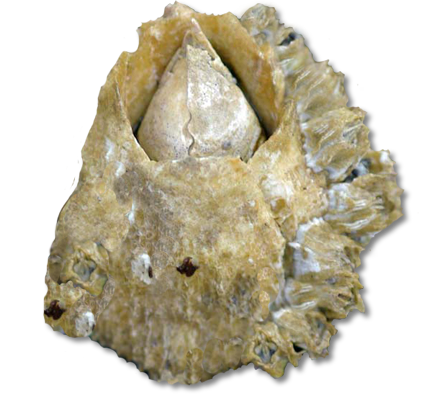
 Acorn barnacles
 Research Study 1
An early study at the University of Washington, Seattle describes initial stages of settlement and attachment in the subtidal barnacle Balanus crenatus. The cyprid larva at the time of settlement is about 0.1mm in length. After testing the substratum for a suitable spot the cypris attaches momentarily by its probing antennules and then twists onto its dorsal side using its antennules as a lever. The ventral side is now uppermost. Three successive rings of gelatinous tubules are now secreted, forming a suctorial film that serves in initial attachment prior to cementation (Fig. 1). The final

Research Study 2
There are four main attachments or “adhesions” during the life of a barnacle: 1) temporary attaching by the antennules as the cyprid “walks” and tests the substratum, 2) cementing of the antennules to the substratum surface, 3) cementing of the “pinhead” barnacle juvenile to the substratum at about 1wk of age, and 4) cementing of the adult during its growth. Each process but the third one is fairly well known in terms of its adhesive mechanics. Barnacles are among the commonest fouling organisms in the marine environment, and it is in relation to them that most anti-fouling research and development has been dedicated. Marine biochemists have extracted and purified barnacle adhesive proteins for use in dental and other medical purposes, such as repair of teeth, bone, and blood vessels. The advantage of barnacle and other cements is they are non-toxic, set in an aqueous environment, and have low immunogenicity in humans. They are also exceedingly
Research Study 3
In Balanus nubilis (Fig. 1) the cement glands are intermixed with ovarian follicles embedded in connective tissue. This species has a membraneous base and so the soft tissues are cemented directly to the substratum (Fig. 2).


Research Study 4


The second type of “adhesion” noted in the introductory section above occurs when the cyprid identifies a suitable spot to settle and metamorphose. At this time, large paired cement glands within its body release their secretions from openings on the attachment or adhesive organs, cementing the antennules firmly to the substratum (Fig. 1). The glue is a complex insoluble protein that is arguably the most durable and toughest in marine organisms. The adhesive secretion has low-viscosity at first, but soon hardens. In species such as Balanus glandula that have a basal plate, calcium secretion and cementing solidifies the basal plate on which the rest of the body sits. Metamorphosis involves thickening of this plate by formation of calcified cuticle, migration of the cement glands into the lower lateral portions of the body, and moulting of the larval carapace and exoskeleton. In the meantime, the outer test plates begin to be secreted by the cuticle (Fig. 2). As the barnacle grows and its need for cement increases, new cement glands develop and form clusters on either side of the body.