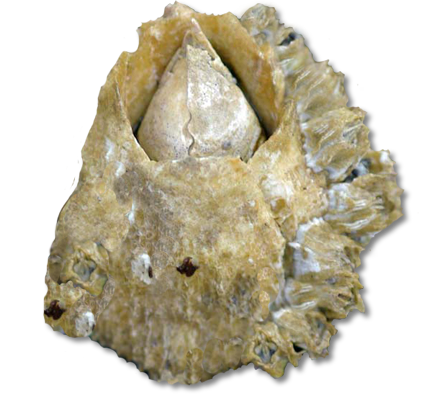
 Acorn barnacles
 Research Study 1


Studies at Friday Harbor Laboratories, Washington show that cyprid larvae of Balanus glandula and Semibalanus cariosus settle preferentially on experimental substrata bearing microflora characteristic of a lower intertidal level, rather than that of a higher intertidal level. The experimental substrata consist of slate plates, 15 x 15cm in size and scored with grooves, set out in both high and low positions on the shore (vertical separation of 1m, high plates at 1.2m above MLLW) for 3mo over winter. After this conditioning, involving settlement of bacteria, diatoms, and algal sporlings, and coincidental with the first appearance of cyprids in the plankton, half the plates at each location are reciprocally transferred to the other location. After 4d they are removed and numbers of spat of each barnacle species
Strathmann 1979 In, Reproductive ecology of marine invertebrates (Stancyk, ed) U South Carolina Press, Columbia
Research Study 2


Studies at Friday Harbor Laboratories, Washington show that some barnacle species preferentially settle in empty adult tests. These unique microhabitats are common in some areas, occupying as much as 0.5% of the rock surface. The walls of the old tests protect the early settlement stages from temperature extremes, desiccation, mechanical damage, and predators. Fig. 1 shows densities of settled Balanus glandula cyprids in tests of barnacles, on bare rock, and under brown algae Fucus sp. Note the general preference for settling in empty tests of the small barnacle Chthamalus dalli. Balanus settles broadly in all tidal zones but survives to reproduce only in the high intertidal zone. Other data presented by the authors show that cyprids of Semibalanus cariosus settle more in the low intertidal area and display no significant preferences for tests of other barnacle species over bare rock and under Fucus plants. Not only do cyprids of B. glandula gain a measure of protection from drying and wave forces by preferentially settling in empty tests (Fig. 2), they are exhibiting a bet-hedging strategy for survival because barnacles have previously lived on these spots. The authors also note that littorine snails Littorina scutulata and L. sitkana commonly inhabit empty barnacle tests, and tend to exclude settling barnacles by eating them, disturbing their settling behaviour with their shells, and passively occupying potential settling space (Fig. 3).
Research Study 3


In Santa Barbara, California sea mussels Mytilus californianus are often found with growths of barnacles Balanus glandula and Chthamalus fissus, and limpets Lottia scabra, on their shells (Fig. 1). Given that it is risky for the larvae to settle on or around mussels because they could be sucked in and eaten, the question arises as to which substratum, rock or mussel shell, represents the best substratum for growth and survival. In other words, is there any selective advantage for a barnacle larva to settle preferentially on one substratum or the othe? First, size of barnacles does not differ significantly on the two substrata (Fig. 2). Second, growth rate of B. glandula does not differ significantly on the two substrata (Fig. 3). However, survivorship of the barnacles is significantly better on mussels than on rock (Fig. 4), indicating that a mussel may ultimately be the superior settlement substratum. Is selection leading, then, to mussel-preferring barnacles in this region? Not likely. The author notes that the availability of rock area and mussel area vary inversely, and since a larva cannot predict what the conditions will be where it lands, nor how much of a particular substratum will be available to it, it would be adaptive for a species to retain the ability to recruit to both rock and mussel rather than to specialise.