
Fig. 1. A few of the myriad factors affecting settlement of the cyprid larva of a barnacle
Many stimuli affect settlement of a cyprid larva (Fig. 1). These include strength and direction of water currents, surface texture (concavities are preferred), light (direction, intensity, and wavelength), gravity, and hydrostatic pressure. Larvae of intertidal barnacle species are primarily photopositive. These larvae stay at the surface of the sea and settle in the intertidal zone. In comparison, larvae of subtidal species tend to be photonegative and remain so while settling to the deeper parts of the shore. Add to these factors the chemical features of the substratum, and the world of the settling larva becomes complex, indeed. As little or no research has been done on precise factors affecting settlement of west-coast species, some information from other world studies is included in the way of introduction.
Research Study 1

Fig. 1. Spat of barnacles Balanus glandula are neatly spaced
in grooves on a mussel shell Mytilus californianus

Fig. 2. Preferential settlement of Balanus glandula larvae into a crack in the rock
Larvae of barnacles Balanus glandula preferentially settle in depressions (Fig. 1) and cracks (Fig. 2).
Test Your Understanding
What advantages accrue from the behaviour of cyprid larvae to settle in cracks and depressions? Think about the suggestions below, then seek explanations.
[Click each option to see commentary]
Research Study 2

Fig. 1. An old established adult Balanus glandula with numerous other barnacles settled onto its shell plates
Settling cyprid larvae are highly responsive to the presence of conspecifics, and they preferentially settle on or near to adults and even to scars of adults that previously lived there. Laboratory studies on Balanus balanoides in Wales show that a protein-chemical called “arthropodin” is the stimulating factor. Note in Fig. 1 that not only does the large adult Balanus glandula have conspecific spat settled on its shell plates, but several generations of another barnacle Chthamalus dalli are also present.
NOTE (lit. “belonging to arthropods” G.) The name was coined in the late 1950’s by its discoverer, D.J. Crisp, for a quinone-tanned protein substance found in arthropods and a few other marine organisms. Quinone-tanned proteins are structurally hard and are present in vertebrates in nails and hair
Research Study 3

Fig. 1. Perception by barnacle larvae of settlement cue arthropodin at the molecular level
Perception by the settling larvae of Balanus balanoides for arthropodin is at the molecular level. By repeatedly coating slate plates with single molecular layers of arthropodin, larvae can be tested for sensitivity (Fig. 1). Note that only one or two molecular layers are all that are required for recognition by the larvae.
Crisp 1965 In, Proc 5th Mar Biol Sympos, Goteborg (ed. Levring) Almquist & Wiksell
Research Study 4

Fig. 1. Dense settlement of Chthamalus dalli amongst Balanus glandula. Based on the statistics provided above for C. fissus, each successful adult recruit of Chthamlus requires the production of over 3000 nauplii
A 2yr study of three species of acorn barnacles around Santa Cruz, California reveals that larvae of Chthamalus fissus settle throughout the year, while those of Balanus glandula settle during a May - June seasonal peak, and ones of Tetraclita squamosa settle “tightly” during a seasonal peak in Oct - Nov. Annual recruitment for Chthamalus counted on a 150-cm2 area is 2 million nauplii yielding 600 recruits; for Balanus: 1.4 million nauplii yielding 160 recruits; and for Tetraclita: 0.3 million nauplii yielding 15 recruits. The author notes that Chtamalus’ life-history characteristics allow it opportunistically to exploit conditions in an extreme and changing environment (Fig. 1), while those of Balanus allow it to dominate at lower intertidal levels for parts of the year.
Hines 1979 In, Reproductive ecology of marine invertebrates (Stancyk, ed.) U South Carolina Press, Columbia
Research Study 5

Fig. 1. Paired antennules in a cyprid larva of Balanus sp. test the substratum for presence of settlement cues
At the end of each antennule of a Balanus cyprid is a disc surrounded by a curtain-like velum (Fig. 1). Clustered on each disc are cuticular bristles, sensory hairs, and glandular openings. As it explores the sea bottom, the larva “walks” on its antennule tips. At each “step” it is thought that proteinaceous enzymes are released from the glandular openings that allow chemical identification of the substratum surface. The curtain-like velum is believed to isolate the chemical reactions from outside seawater dilution.
NOTE the velum is not shown in the "attachment organ" drawing below
Crisp et al. 1985 J Colloid Interface Sci 104: 40
Research Study 6

Fig. 1. Chemical footprint of a cyprid
The step-by-step passage of a cyprid walking along the sea bottom on its antennules can be monitored from its substrate-digested “footprints”. These have been photographed in an Atlantic species Balanus balanoides, allowing its track to be followed as it walks along (Fig. 1). The antennule of the cyprid appears to attach temporarily to the substratum, then shakes free, and then the other antennule attaches. Left behind are chemical residues in patches of organic matter about 50µm diameter by 0.015µm thick, readily visible in scanning e-microscope photos. The “stepping” distance of a 1mm Balanus cyprid is about 660µm, or two-thirds of its carapace length. Based upon the size of the antennulary glands and the estimated volume of their secretions, a cyprid could walk for about 600 “steps”, or about 40cm, before exhausting its supply of secretions. Thus, depending upon how long it takes to replenish the stock, this could set a limit on total stepping distance and number of sites explored. The authors note the possibility that these chemical “footprints” could be stimuli for gregarious settlement of larvae.
Walker & Yule 1984 J Mar Behavior UK 64: 679
Research Study 7

Fig. 1. A whelk Nucella ostrina appears to be preying on spat of Balanus glandula that have settled around the bases of several adult Semibalanus cariosus. Note as well a few recently settled spat of Chthamalus dalli (small and dark) scattered about
On rocky shores in San Juan Island, Washington and in other similar west-coast locations, barnacles Balanus glandula and Semibalanus cariosus occupy high and low zones on the shore, respectively. The upper and lower limits of distribution of Balanus are set by tolerance to drying/extreme temperatures and by predation, respectively. The upper limit of S. cariosus is also set by mortality of young stages through desiccation or extreme temperatures. When settling, the cyprid larvae of both species tend not to settle above the zone in which they can survive, but how do they differentiate between a spot on the shore that will remain moist and cool during low tide versus one that dries or heats to an extent that will kill them? Observations in San Juan Island, Washington suggest that the cyprids recognise the presence of indicator species, most likely species of diatoms or other microorganisms. Since the same factors that kill newly settled barnacles also kill potential indicator species, the absence of the latter will signify to the cyprids that the site is unfavourable. If this is true, then cues for recognition of the upper edge of the Balanus intertidal range should be more effective than cues for recognition of the lower edge of the range. This is because predators such as whelks that kill off the newly settled Balanus at the lower edge of their distribution (Fig. 1) would not usually kill off the potential indicator species. Thus, the habitat boundaries set by predators are likely to be poorly correlated with such indicator species. This is an interesting hypothesis, which would repay further investigation with other invertebrate species.
NOTE the authors use settling plates set out at different intertidal levels to assess the relative importance of different factors. Their data suggest that drying and temperature are the most important, while light/shade are unimportant
Strathmann & Branscomb 1979 In, Reproductive ecology of marine invertebrates (Stancyk, ed.) U South Caroline Press, Columbia
Research Study 8

Fig. 1. Whale barnacle
Coronula diadema (1cm dia) almost totally embedded in the skin of a beached juvenile humpback whale
Megaptera novaeangliae. The barnacle's cirri are visible within the open mantle cavity
Courtesy Semiahmoo First Nation, Southern British Columbia
There are several types of barnacles that are parasitic on other animals, such as molluscs, crustaceans, sea turtles, and whales, to name a few. Larvae of species that inhabit benthic invertebrates should have no special challenges in finding their hosts, other than following chemical gradients to them, but what of a larva of a whale barnacle Coronula diadema that requires to seek out a humpback whale Megaptera novaeangliae (Fig. 1)? It is only from recent research in Japan that we learn that the larval development of C. diadema is similar to that of other barnacles, with 6 naupliar stages leading to a settling cypris stage (Figs. 2 - 5). Scientists from the Environmental Research Laboratory at Chiba, Japan are able to settle and metamorphose the larvae successfully, but only in the presence of a piece of skin from the original host whale. The only unusual feature of the post-metamorphic barnacle is apparently the presence of a ring-shaped structure with spines that may function in holding the juvenile to the whale. The authors do not comment on how the cyprid finds its host or climbs aboard, other than it presumably is done in response to a chemical cue from the whale’s skin. However, consider this: a cyprid attempting to intercept a swimming whale is not like a person trying to jump on a speeding train. As it swims or brushes close to the whale's surface, the larva will enter a velocity gradient that drops to zero at the boundary layer just at the skin surface. Thus, settlement could theoretically be done with the host in motion, as the settling cyprid would be entrained in the boundary layer, with no sensation of the whale's motion
NOTE the authors refer to the barnacles as obligate commensals, a term that seems to be popularly used to describe the nature of this particular symbiotic relationship. However, as there may be several thousand such barnacles on a whale, and as they damage their host’s skin, represent additional mass to be transported, and significantly increase frictional drag through the water, they really should be termed parasites. By definition, commensals gain benefit from a relationship but do not harm their hosts
NOTE 8-cell embryos from barnacles from a stranded humpback whale are cultured to competent cyprids after 6mo at 25oC. The nauplii are fed diatoms Chaetoceros gracilis at a concentration of 4 x 10⁵ cells • ml-1

Fig. 2. Start of photo series showing developmental stages of whale barnacle Coronula diadema: here, newly hatched nauplii

Fig. 3. 6d-old nauplius

Fig. 4. Cypris larva

Fig. 5. Adult
Nogata & Matsumura 2006 Mar Biol Lett 2 (1): 92
Research Study 9

Fig. 1. Top and side views of acrylic UV-light filter installed
Does ultraviolet light play a role in selection of settlement sites by barnacles? This is tested at the Bamfield Marine Sciences Centre, British Columbia by installing acrylic-plastic UV-light filters on freshly cleared rock surfaces. The 12cm diameter filters (Fig. 1) will either allow passage of ultraviolet radiation and visible wavelengths (full spectrum), or screen out all UVA and UVB wavelengths allowing only visible wavelengths to pass through. Sites without discs serve as filter-free controls. After installing the discs the sites are monitored daily for 2wk for settlement of cyprids and survival of spat of Balanus glandula. Results show no significant effect of UV radiation on settlement of larval barnacles, indicating that settlement behaviour in this species does not involve avoidance of UV-exposed surfaces. Post-settlement survival is, however, significantly better in UV-protected treatments, but only by about 10%, and only over the period from settlement to metamorphosis (1 - 2d). Survival of post-metamorphic juveniles is not significantly affected by UV. Exposure to sunlight, however, does affect survival of newly metamorphosed juveniles, killing up to 100% of daily cohorts when doses are highest, likely through desiccation and heat stress, not through UV-exposure. The authors discuss the implications of impending climate change on survival of barnacles and other settling organisms.
NOTE test sites are scraped to remove all macroscopic organisms, wire-brushed, and sterilised by burning with a propane torch
NOTE ultraviolet A and ultraviolet B wavelengths (300-400nm)
Gosselin & Jones 2010 Mar Ecol Progr Ser 407: 149
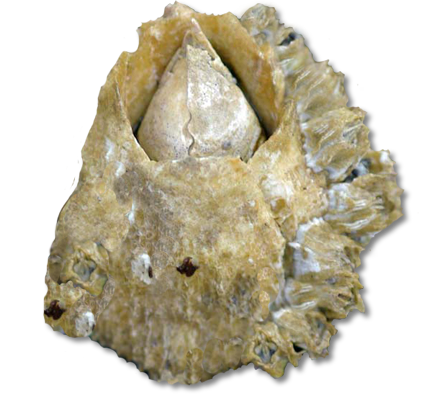 Acorn barnacles