This section on reproduction is organised alphabetically by species.

Fig. 2. Developmental stages of Balanus crenatus (proceed clockwise from nauplius)

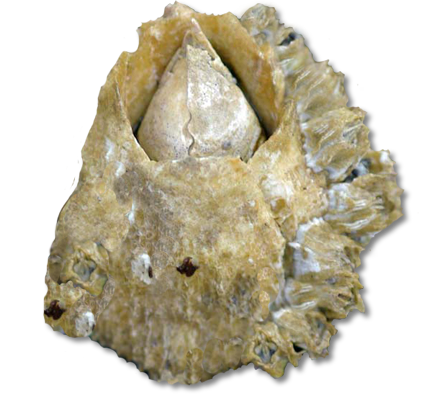
Fig. 1. Barnacle
Balanus crenatus attached to the carapace of a Dungeness crab
Metacarcinus magisterCourtesy Dave Cowles, Walla Walla University, Washington
Studies on development of Balanus crenatus at Pacific Grove, California provide information on naupliar and cyprid morphology. The author divides development into 8 naupliar stages instead of the usual 6. The cypris is 0.55mm long. Development through metamorphosis takes 2 - 3wk (summer lab-seawater temperatures of 17 - 21oC).
Herz 1933 Biol Bull 64: 432
Research Study 1: Balanus glandula

Fig. 1. There are several advantages to gregarious settlement in
Balanus glandula, one of which is ensuring access to copulatory partners
Courtesy Dave Cowles, Walla Walla University, Washington

Fig. 2. Developmental stages of Balanus glandula
As in other acorn barnacles, fertilised eggs in Balanus glandula (Fig. 1) are retained in the mantle cavity until they hatch to nauplii arvae. After their release from the parent the nauplii swim and feed on phytoplankton using three pairs of appendages (Fig. 2). After a few weeks, during which time the nauplius moults five times, it transforms into a settling stage known as a cypris. The cypris is non-feeding, but is loaded with fat droplets for buoyancy and energy. The cypris soon drops to the sea bottom and begins searching for a place to settle. Special sensory endings on each antennule enable the cypris to assess the minute physical and chemical features of the sea bottom. When a suitable place is found, the larva attaches via sticky secretions from the antennae and begins to metamorphose.
Brown & Roughgarden 1985 J Crust Biol 5: 574
Research Study 2: Balanus glandula

Fig. 1. Relationship of mantle-cavity volume to number of eggs being incubated in Balanus glandula
In Ladysmith Harbour, British Columbia reproduction in Balanus glandula follows this schedule at water temperatures of 6 - 8°C:
- fertilisation (eggs 0.15mm dia): Dec - Jan
- eyed nauplii in mantle cavity: end of Feb
- nauplii released: Mar
- all nauplii gone: mid-April
There may be an additional, smaller, spawning in autumn at 15 - 18°C. Fig. 1 shows number of embryos in egg masses of gravid Balanus glandula at Ladysmith Harbour, British Columbia, plotted against estimated volume of the adult (length in mm3). Maximum brood size is about 12,000.
Comparative data on the same species in La Jolla, California:
- fertilisation: Oct
- eyed nauplii in mantle cavity: end of Dec
- nauplii released: Jan
- all nauplii gone: mid-Feb
There may be a smaller brood produced in springtime.
NOTE the incubatory volume in the mantle cavity of a barnacle scales roughly as the cube of length. Numbers of eggs/embryos represent an estimate of volume; hence, the relationship is predicted to be linear. The estimate is crude and further research on this relationship in different species would be useful
Barnes & Barnes 1956 Pac Sci 10: 415
Research Study 3: Balanus glandula

Fig. 1. Tetraclita squamosa

Fig. 2. Comparison of numbers of broods produced by barnacle species Tetraclita squamosa, Balanus glandula, and Chthamalus fissus in central California. Each peak in the schematic is roughly equivalent to a brood
The previous Research Study suggests that Balanus glandula in British Columbia has only a single brood during the year, but a comparison of three species of barnacles, including B. glandula, in central California indicates several broods in this species, as well as wide variability in reproductive cycles among the species. Thus, Balanus glandula produces 3 - 6 relatively large broods from Dec - May, while Tetraclita squamosa (Fig. 1) produces three intermediate-sized broods from Jun - Sep, and Chthamalus fissus produces up to 16 small broods from Mar - Oct. The broods are produced in rapid succession, with occasional overlap between them. In the laboratory, brood frequencies in all species appear to be regulated primarily by food availability, and not by temperature (except possibly for T. squamosa) or photoperiod. The accompanying schematic (Fig. 2) shows the patterns of nutrient storage in the ovaries of the three species, expressed as number of brood equivalents (in mass) in the ovary. In C. fissus a brood is deposited as soon as enough nutrients are accumulated. This is slow in late autumn and winter, but speeds up as more food becomes available during spring and summer. In contrast, B. glandula stores nutrients for at least three broods during summer then broods up to 6 times from Dec - Apr, storing nutrients during springtime feeding. Finally, T. squamosa accumulates yolk for only one brood at a time, for a total of three during the summer. The author groups barnacle species into five categories based on patterns of reproductive timing and brood production, and the present paper illustrates three of these patterns.
NOTE the author studies barnacle reproduction in two areas, one, a warm-water discharge canal of a large power plant at Morrow Bay, California (discharge temperatures are 5°C above ambient); the other, nearby shore populations living at ambient temperatures. Only T. squamosa shows significant differences in reproductive cycling in the two locations
Hines 1978 Biol Bull 154: 262
Research Study 4: Balanus glandula

Fig. 1. Shore heights occupied by acorn barnacles Chthamalus fissus, Balanus glandula, and Tetraclita squamosa

Fig. 2. Seasonal brooding in barnacle species Chthamalus fissus, Balanus glandula, and Tetraclita squamosa in central California
Three species of acorn barnacles are common on intertidal shores around Santa Cruz, California. Chthamalus fissus at 8mm maximum diameter lives in the highest regions, extending into the splash zone to about 2.2m above MLLW (Fig. 1). Balanus glandula at 2cm diameter is most abundant in the mid-high zone from 1 - 1.5m above MLLW, and Tetraclita squamosa at 6cm diameter occupies the low intertidal area from 0-1m above MLLW. Brooding in C. fissus occurs Mar - Oct, in B. glandula Dec - May with up to 6 broods per season, and in T. squamosa Jun - Sept with up to three broods per season (Fig. 2).
NOTE the three species are considered together here for convenience
Hines 1979 In, Reproductive ecology of marine invertebrates (Stancyk, ed.) U South Carolina Press, Columbia
Research Study 5: Balanus glandula

Fig. 1. Fertilisation success in Balanus glandula
A common assumption is that aggregation in barnacles principally serves to increase fertilisation success between neighbouring mature adults through increased penis access. However, studies at the West Vancouver Laboratory, British Columbia on Balanus glandula show that there is no significant effect in this regard at nearest-neighbour distances less than 1.75cm (Fig. 1). But, at 5cm distance the adults are out of effective penis-reach distance.
NOTE although the author concludes that distance represented by maximum penis length of a mature individual has no effect on fertilisation success in B. glandula, the data leave a sizeable and possibly critical gap between the 1.75 and 5cm distances, and perhaps this should be re-examined. The gap may be explained by the fact that the author uses an array designed to test another unrelated hypothesis and does not specifically create a new design to generate new data specifically to test the present hypothesis. This is not good science. Barnacle diameter, moreover, is not provided, and so average or even maximum penis length to be expected in the test population is unavailable to the reader. The research protocol in this study could have been improved
Wu et al. 1981 Can J Zool 59: 890
Research Study 6: Balanus glandula

Fig. 1. Partially extended penis of Balanus glandula

Fig. 2. Effect of wave velocity on penis length in Balanus glandula

Fig. 3. Effectiveness of a longer penis in Balanus glandula increases as the square of penis length
Barnacles cross-fertilise with a penis that may be 8 or more times longer than their body diameter (Fig 1). Evolution in barnacles has been a trade-off between an ever-increasing penis length to service more mates and a need to control these longer penises in turbulent waves and currents. It is not so all-or-none, however, for a study at the Bamfield Marine Sciences Centre, British Columbia shows that at least one species, Balanus glandula, has phenotypic plasticity in penis morphology, permitting individuals in wave-exposed areas to have shorter, stouter, and more massive penises than ones in wave-protected areas. Thus, variation in penis size and shape correlates with maximum velocity of breaking waves (Fig. 21). On average, quiet-water individuals have penises2 that are 25% longer than rough-water individuals. Note in Fig. 3 that a 25% increase in penis length in quiet-water habitats translates into a 90% increase in reachable3 area. Penis size also scales allometrically with body size, leading to disproportionately stouter penises in larger animals. For final confirmation, the authors translocate barnacles to different habitats and show that, after 20wk, individuals moved to wave-exposed shores produce shorter (by 25%) and wider (by 20%) penises than ones moved to a protected harbour, confirming that the size variation in penises owes to phenotypic plasticity. The phenotypic flexibility in penis size enables B. glandula to inhabit a greater range of habitat conditions than would otherwise be possible.
NOTE1 the graph presented here shows the relationship of penis length and wave exposure, but the authors provide data on penis basal width and mass relative to both body size and penis length that also correlate significantly with wave exposure. The data in the graph are expressed for "standard"-width barnacles of 8mm
NOTE2 how do you measure the size of a barnacle penis? It requires use of a dissecting microscope with ocular ruler, Inflate the penis, confirm that the size of a relaxed (i.e., dead) penis is a valid indicator of extended penis length, and measure its dimensions
NOTE3 as copulatory partners are accessible around the entire circumference of the barnacle, the searchable area expands as the square of penis length
Gaines et al. 1985 Oecologia 67: 267
Research Study 7: Balanus glandula
In a follow-up paper to previous work on the same topic in goose barnacles researchers from the University of Alberta provide genetic evidence of spermcast "mating" in the acorn barnacles Balanus glandula and Chthamalus dalli, species hitherto thought to cross-fertilise with their relatively long penises (as much as 7 - 8 times their body length) or to self-fertilise. Although the incidence of spermcasting in these species, at around 8%, is much lower than that recorded for the stalked barnacle Pollicipes polymerus), their data show that it does occur even in long-penised species. The finding also requires researchers to rethink the long-held belief that the presence of fertilised eggs in isolated barnacles is an indication of self-fertilisation. The effective distance of spermcasting in the barnacle species studied appears to be no farther than 10 body lengths. Still, it makes up somewhat for penis-length-challenged deficiencies.
NOTE spermcasting involves release of sperm by one individual into the open water that is captured by another individual and used to fertilise its own eggs internally. It differs from broadcast spawning that involves simultaneous release of eggs and sperm from different individuals with fertilisation occurring in the open ocean
Baraandeh et al. 2014 J Exper Mar Biol Ecol 454: 49
Research Study 8: Balanus glandula
Researchers at University of California, Santa Cruz and University of Hawaii construct a model for naupliar development of Balanus glandula based on published data on effects of temperature and food concentration on rates of growth. The model uses total chlorophyll to represent food concentrations in the field which, because of variability in nutritional content of different phytoplankton species, may lead to larval developmental rates being over-estimated. Still, durations of larval life predicted from the model compare favourably, perhaps not surprisingly, with previous observations of larval duration of the species. The authors suggest that their model will be a useful tool in simulations of larval dispersal under varying conditions of current flow, upwelling, and so on.
NOTE the cyprid stage is non-feeding; hence, is not included in the model
Pfeiffer-Hoyt & McManus 2005 J Plankton Res 27 (12): 1211
Research Study 9: Balanus glandula

Fig. 1. Schematic of density treatments in sexual-allocation study in Balanus glandula
As simultaneous hermaphrodites, barnacles have both sexes contained within the same body and both sexes mature at the same time. Given that self-fertilisation does not occur, or occurs only rarely, what is the relative investment1 into male and female function in an individual (i.e., equivalent to sex ratio) in a species? Previous theoretical models developed specifically for acorn barnacles predict that relative allocation to male function will increase as number of competitors for fertilisations increase. This is tested in a field study at Friday Harbor Laboratories, Washington for Balanus glandula2 under different levels of crowding. Experiments are done on mid-intertidal-level populations manipulated by selective removal of individuals to form four experimental treatments containing low or high numbers3 of individuals in dense or sparse aggregations (Fig. 1). Each treatment occupies 10 x 10cm area of rock surface and is separated from each other treatment by a 5cm distance to prevent mating outside of the treatment group. Six replicate sites are used. After 4wk, investment is measured in selected individuals from each treatment at each site. Results are complex, but show that while allocation to male function does not change as predicted with number of competitors, it is affected by body size (greater relative allocation to female function with increasing size) and site, and does increase with increased crowding. How the barnacles perceive the density of crowding in an aggregation is not known, but common ideas are that it could relate to perception of chemical emanations, to a sense of non-self test-plate proximity, or perhaps even to intensity of penis probings. The topic is a challenging one, and is certain to generate further research.
NOTE1 investment is defined for females as total mass of eggs, and for males as total mass of reproductive parts including testes, ducts, and penis. The authors note that their definition of “investment” is just one method that could be used. Other measures of investment that have been used for similar studies in other hermaphroditic taxa as, for example, sea hares Aplysia, are frequency and duration of the copulatory act, and these parameters might have been useful for this study as well
NOTE2 the researchers do a parallel study on an Atlantic species Semibalanus balanoides, results for which are not considered here
NOTE3numbers of individuals are 3 - 4 or 10 - 25, and are touching one another in dense aggregations, but physically separated in sparse aggregations
Hoch & Levinton 2012 Evolution 66 (5): 1332
Research Study 10: Balanus glandula

Fig. 1. Unhatched nauplii of Balanus glandula still attached to the parent, and presumably still contained within their egg-capsule membranes

Fig. 2. Pygmy crab Glebocarcinus oregonensis and Nucella ostrina, predators of acorn barnacles

Fig. 3. Whelk Nucella ostrina
In Balanus glandula, nauplii larvae that are competent to swim can be held by the parent within their egg capsules for some time until conditions are suitable for their release (Fig. 1). The time spent in this immotile state varies depending upon season, with winter-brooded larvae spending longer as the adults wait for the advent of springtime hatching stimuli, such as warmer temperature, more light, and phytoplankton blooms. Summer-brooded larvae, in contrast, are released into more regularly available food conditions after shorter periods of brooding than the winter ones (means of 16 and 45d, respectively, in the present study). This plasticity in time of hatching and release has obvious survival benefits. Other environmental factors that may come into play include feeding activities of predators), and it is about how the different behaviours of certain predators differently affect survival of the nauplii that researchers have investigated at Friday Harbor Laboratories, Washington. For example, when crabs such as Glebocarcinus oregonensis (Fig, 2) attack a brooding barnacle they tend to crush the shell plates, allowing many of the nauplii to hatch from the brood lamellae and swim safely away. In comparison, when whelks such as Nucella ostrina (Fig. 3) attack a brooding barnacle by boring through or between the plates, the shell plates including the opercular ones most often remain intact, trapping larvae within the brood lamellae and/or within the mantle cavity, and causing their deaths. By dissecting gravid barnacles and separating lamellae in the laboratory, the authors confirm that physical damage such as that caused by crabs will often cause larvae to be released.
NOTE the proximal stimulus for hatching is thought to be a pheromone released by the brooding parent, but hatching can also be stimulated by experimentally separating the encapsulated nauplii from the egg lamellae, as well as by other disturbances
NOTE formerly Cancer oregonensis
Branscomb et al. 2014 Invert Biol 133 (2): 158
Research Study 1: Balanus nubilis

Fig. 1. Six naupliar stages of giant barnacle Balanus nubilis
Naupliar development in the giant barnacle Balanus nubilis is similar to that described for other balanoid species, but of a larger size. Studies on B. nubilis larvae in laboratory-culture at Friday Harbor Laboratories, Washington provide information on general morphology and carapace widths.
NOTE the authors use stage I-III nauplii from lab culture and stage IV-VI nauplii from plankton tows
NOTE carapace widths are measured as the distance between the frontal-lateral horns. The authors note that stage I nauplii are not usually free-living, but are recognisable by their posteriorly directed horns
Barnes & Barnes 1959 Can J Zool 37: 15
Research Study 1: Chthamalus dalli

Fig. 1. Aggregation of Chthamalus dalli with a few scattered Balanus glandula. A single C. dalli is highlighted - isolated, yes, but not sterile
Can barnacles self-fertilise? Such a strategy would be of survival value particularly to Chthamalus spp., where isolated individuals commonly occur high up the shore. The answer is “yes” for both C. fissus and C. dalli (Fig 1) on the west coast. This is confirmed for the former species in Santa Monica and Malibu Beach, California, and for the latter species in Coos Bay, Oregon, and Anacortes and San Juan Islands, Washington. The authors examine contiguous and separated (> 5cm) populations for the presence of viable embryos and larvae. In all instances, the separated individuals lag behind their contiguous conspecifics in terms of stage of development, suggesting that they wait for cross-fertilisation, and only self-fertilise as a last-ditch strategy.
NOTE the authors confirm self-fertilisation in other European barnacle species, but it is not known whether this occurs in west-coast barnacles other than Chthamalus
Barnes & Barnes 1958 Ecology 39: 550
Research Study 2: Chthamalus dalli

Fig. 1. Photograph of a clone of aggregating anemones Anthopleura elegantissima with numerous barnacles, in this case, Chthamalus dalli (grey, small) with Balanus glandula (white, larger). Within the approximated 1cm-distance line are many Chthamalus
Along with several other species of barnacles in southern California, acorn barnacles Chthamalus fissus are commonly infected with an isopod parasite Hemioniscus balani that in female barnacles leads to parasitic castration1. As the barnacles are commonly found near to sea anemones Anthopleura elegantissima that subsist on small planktonic crustaceans, two California university researchers wonder if predation by anemones on planktonic juvenile stages of the parasite might reduce infection rates on barnacles growing nearby (Fig. 1). First, the researchers confirm that anemones in the laboratory readily feed on the transmission stage of the parasite. Next, through assays of parasite presence in relation to barnacle reproductive productivity in adult barnacles near to (< 1cm distant2) and far from (> 10cm) anemones, they find that the first group has a 28% infection level, and the second group, a 70% level. Moreover, while 23% of the first group are actively reproducing, only 7% of the second group are so doing. Finally, and after a not unreasonable amount of inference3, the authors conclude that close location of C. fissus to A. elegantissima does confer a significant level of protection from the parasite.
NOTE1 the parasite enters a barnacle as a planktonic swimming juvenile, known as a cryptoniscus, attaches near the host’s ovaries, and feeds on the fluids within. Their presence deleteriously affects ovary health and blocks reproductive function. At maturity, the parasite releases its offspring and then dies
NOTE2 at Coal Oil Point, Santa Barbara at the tidal height surveyed, about 30% of all C. fissus are within 1cm of an anemone
NOTE3 the authors discuss in detail other possible explanations for their data and basically conclude, a la Sherlock Holmes, that “when you have eliminated the impossible, whatever remains, however improbable, must be the truth”…simply elementary, dear reader...
Fong & Kuris 2017 Parasitology 144: 917
Research Study 1: Megabalanus californicus

Fig. 1.
Megabalanus californicus reaches sizes of 3cm diameter
Courtesy Ray Ellersick & Flickr

Fig. 2. Larval stages of Megabalanus californicus
Larvae of the large barnacle Megabalanus californicus (Fig. 1) from California are described for the first time. Note the large sizes of the various stages (Fig. 2; the cypris is about 1cm in length).
Fong & Kuris 2017 Parasitology 144: 917
Research Study 1: Semibalanus cariosus

Fig. 1. Semibalanus cariosus
Release of nauplii by Semibalanus cariosus (Fig. 1), and perhaps other species, is synchronised with the spring plankton bloom. It makes sense that an invertebrate species with phytoplankton-eating larvae would spawn or release their larvae synchronously with the seasonal phytoplankton bloom but, unlike sea urchins and mussels that spawn their gametes in response to a chemical produced by the phytoplankton, barnacles appear to release their larvae in response to physical contact with the phytoplankton cells.
Starr et al. 1975 Can J Zool 53: 582
Research Study 2: Semibalanus cariosus

Fig. 1. Naupliar stages of Semibalanus cariosus
A study at Friday Harbor Laboratories, Washington provides details on naupliar development of three barnacle species Semibalanus cariosus, Balanus crenatus, and B. glandula. In contrast to the last two species which breed throughout the year, S. cariosus produces only one brood per year in early spring. Fig. 1 shows the 6 naupliar stages of Semibalanus cariosus.
NOTE as features of the larvae of the other two species are shown elsewhere in this section, only those of S. cariosus are presented here
Branscomb & Vedder 1982 Crustaceana 42: 83
Research Study 1: Tetraclita rubescens

Fig. 2. Tetraclita squamosa from Thailand

Fig. 1. Tetraclita rubescens fom California
Larvae of volcano barnacles Tetraclita rubescens (Fig. 1) from California (compare with Tetraclita squamosa from Thailand; Fig. 2) are described for the first time (Fig. 3).
NOTE long thought to be the same species the World Register of Marine Species acknowledges their separate species status

Fig. 3. Larval stages of volcano barnacle Tetraclita rubescens
Miller & Roughgarden 1994 J Crust Biol 14: 579
 Acorn barnacles