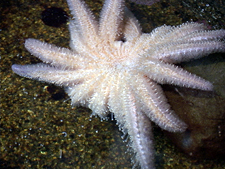
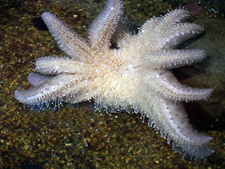
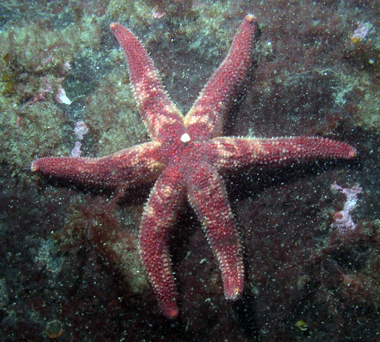
When a sea star finds itself on its aboral surface, that is, upside-down, it endeavours to right itself. Righting has obvious survival value in conditions of rough water and/or shifting substrata, and likely also in protection from predation. The mechanism and behaviour of righting is considered here.
Research Study 1
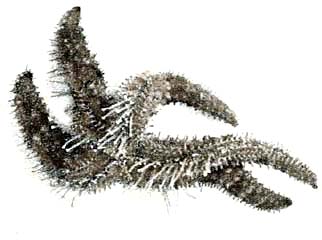
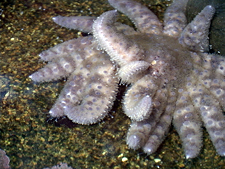
Fig. 1. This photograph purports to show the end of an under-arm creeping sequence of righting by Stylasterias forreri involving initial attachment of four arms, with the free one being swung over, followed by two arms creeping underneath the other two...whew!...where are all the monkeys on typewriters when we need them?
An early study at the marine laboratory in La Jolla, California describes righting in the fish-eating sea star Stylasterias forreri. The author describes several methods used in this behaviour, including somersaulting, twisting, flipping, under-arm creeping (Fig. 1), and raising & toppling, with several variants of each depending upon how many arms are used and the direction of the righting movement. Unfortunately, and perhaps understandably, both the photos and descriptions provided are hard to understand, and the author might have made a better contribution by providing sequential drawings for each of the various methods he (imperfectly) describes.
NOTE the author also devotes several pages to a description of training and learning in Stylasterias but, again, lack of clarity in descriptions and an absence of graphical or tabulated data make the presentation impossible to understand
Jennings 1907 Univ Cal Publ Zool 4 (2): 53
Research Study 2
Fig. 1. Sunflower star Pycnopodia helianthoides righting, using a somersaulting flip from a four-arm attachment
Fig. 2. In this aboral view of Pisaster ochraceus the nerves shown in orange are actually on the oral (lower or mouth) surface
Some west-coast asteroids move so slowly that escape by crawling is not an option. When the tide is out, intertidal species protect themselves by nestling into crevices or anchoring firmly to the substratum. Righting ability of sea stars after being dislodged by a predator or by waves has long been of interest to researchers (Fig. 1). Century-old studies on ochre and bat stars, Pisaster ochraceus and Patiria miniata, respectively, show that righting is initiated from no preferred arm location; rather, the arm whose tube feet first touch the substratum determines the course of the righting. This arm begins at its distal end to twist the aboral side upwards, joined later by one of the adjacent arms, which also obtains a hold and twists. The other three arms and body pass overhead in a somersaulting motion. The nerves controlling righting in Pisaster and other sea stars are the oral nerve ring and the radial nerves (Fig. 2). The former is located around the mouth and the latter extend along the ambulacral grooves. If the oral ring is cut at the location shown in the illustration, righting still occurs, but is less well coordinated and takes up to three times longer than in an undamaged individual. Control cuts made from the aboral surface downwards without injuring the nerve do not disrupt the coordination of righting. The author correctly concludes that there is no “nervous centre”, and proposes that any one of the five arms can give rise to impulses which affect only the two adjacent arms. The author proposes that these impulses would diminish in strength as they travel from their point of origin, thus affecting arms other than adjacent ones imperceptibly (does this make sense, do you think...?)
NOTE the radial nerves are located just under the epidermis in the ambulacral grooves. With care they can be exposed and stripped out. The cut as shown in the image in Fig. 2 is from the oral surface towards the aboral surface, just deep enough to sever the oral ring
NOTE although not relevant to short-term studies as described here, such cuts heal quickly. Thus, experiments lasting longer than a few hours generally require the insertion of some sort of block, as a piece of wax or plastic, to prevent the nerve ends rejoining
Moore 1910 Biol Bull 19: 235 Moore 1910 Amer J Physiol 27: 207
Research Study 3
Fig. 1. Leptasterias hexactis showing ambulacral grooves lined with tube feet and spines
Courtesy Dave Cowles, Walla Walla University, Washington
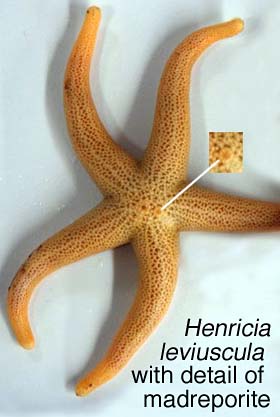
Fig. 2. Blood star Henricia leviuscula showing location of madreporite
Courtesy Dave Cowles, Walla Walla University, Washington
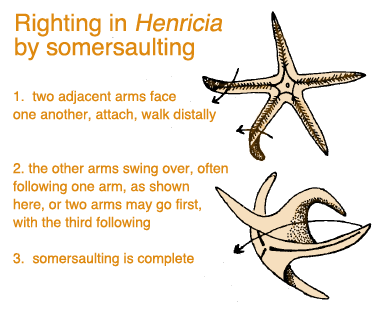
Fig. 3. Righting in Henricia leviuscula
Another question relating to leading arms during locomotion, is whether there a preferred/leading pair of arms used during righting. This is tested in a study in Oregon using Henricia leviuscula and Leptasterias hexactis (Fig. 1). Most asteroids right themselves by somersaulting, or a combination of folding-over and somersaulting, and these two species are no exception. Henricia only rights by somersaulting, while Leptasterias uses both somersaulting and folding-over, sometimes in combination. The authors report a tendency in Henricia for the arm pair opposite the madreporite to lead during righting (Figs. 2 - 3), but with a more general pattern being exhibited in Leptasterias. As expected, size has an effect on righting times, with larger animals taking significantly longer to right. However, the authors do not specifically investigate scaling effects of size and this might be an interesting project for someone. Neither righting method was significantly faster than the other, suggesting no advantage for survival in the field.
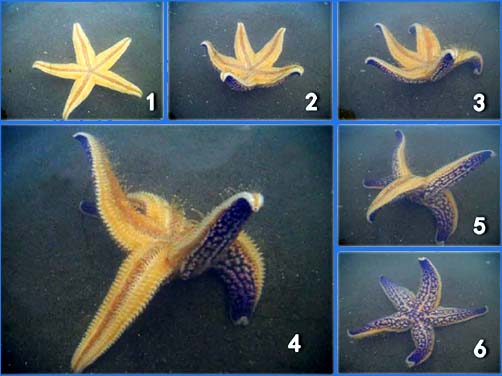
NOTE in somersaulting all five arms curl aborally bringing their tips in contact with the substratum (Figs. 3 - 4). One adjacent pair of arms then twists so that they face one another. These two arms begin to move to the sides causing the remaining arms to rise up and swing over the body. The folding-over method is similar but without the curling of the arm-tips. A third, rarely seen method, involves all arms rising up to form a tulip shape. Several arms then collapse causing the animal to flop over. Interest in the subject dates from 1862
Fig. 4. Another example of somersaulting is provided by a group of student researchers in China for Asterias amurensis. The righting proceeds as described for Henricia: 1) individual is upside-down, 2) arms uniformly rise and curl, 3) two adjacent arms attach, 4) these two arms walk distally, raising the other arms, 5) opposite arm rises up, and 6) body flips over. Somersaulting is complete (Wu et al., 2000)
Polls & Gonor 1975 Biol Bull 148: 68 Polls 1970 MSc Thesis, University of Oregon Wu et al. 2000 Undergrad Innov Prog, China Agricultural Univ, Beijing
Other west coast somersaulters are Pisaster ochraceus and Patiria miniata, while folding-over is also used by Pycnopodia helianthoides. Figs 1 - 4 show a juvenile P. helianthoides righting itself apparently by the folding-over method, although for a multi-armed species it is hard to see the difference between folding-over and somersaulting.
Figs. 1 - 4. Righting behaviour in a juvenile sunflower star Pycnopodia helianthoides
Sunflower star Pycnopodia helianthoides righting itself. One wonders what sensory systems are used for positional orientation in a sea star. How does it sense which way is up?
Research Study 4
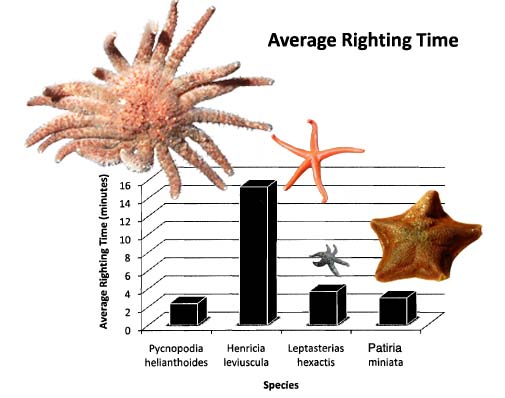
Fig. 1. Righting times in several adult sea-star species with contrasting sizes and life styles. Apart from the sunflower star, is relative arm length seeming to play a role in righting speed?
A comparison of righting behaviour and righting times in four species of sea stars done by undergraduate researchers in an “adaptations of marine animals” class at the University of Oregon is worth mentioning here, especially since it should lead to further follow-up research. Results indicate faster absolute righting times in sunflower stars Pycnopodia helianthoides, which the authors correlate with the species’ faster locomotory ability and predatory life-style (Fig. 1). The authors address the more interesting aspect of relative righting speeds in the four species, but unfortunately are not clear in their definitions of “size of the body” and “body diameter”, so the results are not included here. The study is valuable in the number of questions that come to mind, such as righting times relative to body size and arm length, noted above, and broader questions relating to righting times and habitat occupied, feeding habits, presence of predators, locomotory speeds, and so on.
NOTE species are selected on the basis of “availability and size”, and include Pycnopodia helianthoides, Henricia leviuscula, Leptasterias hexactis, and Patiria miniata
NOTE sample sizes used in the experiments are also small, ranging from single individuals for two species, to three and 6 individuals for the other species. Perhaps for this reason, the authors consider statistical tests to have been inappropriate, although the deficiency could have been easily remedied with additional collecting trips
Pearson & Pedemonte 2008 Res Rep, Adaptations of Marine Animals, Exploratory 1, University of Oregon.
Research Study 5
Fig. 1. Leptasterias aequalis
Courtesy Kirt Onthank and Dave Cowles, Walla Walla University, Washington
Researchers at Louisiana State University and the National Marine Fisheries Service, Alaska compare righting speeds of sea stars Leptasterias spp. collected at San Juan Island, Washington and Lena Cove, Alaska, at different air and water temperatures, and find that righting times of the Washington species are similar in water of 12 - 18oC, but significantly reduced at temperatures above 27oC. Exposure to air for 3h, typical for mid-intertidal-inhabiting Leptasterias spp. has no significant effect on righting activity at 9oC or 15oC, but exposure at 19oC significantly reduces activity. The study is really a physiological/biochemical one, using righting response as a crude measure of metabolic activity, but may be of interest to researchers interested in ecological aspects of righting in asteroids.
NOTE the three Washington species are L. hexactis (48% representation), L. aequalis sp. B (28%; exact species indeterminate), and L. aequalis sp. A (24%; exact species indeterminate), while the Alaskan representatives are predominately L. alaskensis with a few L. hexactis
Stickle & Rice 2010 In, Echinoderms: Durham (Harris et al., eds) Taylor & Francis Group, London
Research Study 6
Fig. 1. Righting times for a variety of sea stars. Times are measured in seconds, rather fussily; minutes would have been more informative. Photos are not in scale
A study by a student researcher at Friday Harbor Laboratories involves comparing righting times of 6 species of sea stars on a seawater table. Results are as expected, with the multi-armed fast-moving sunflower star Pycnopodia helianthoides righting the fastest. Ochre stars Pisaster ochraceus, as might be expected from their bulky shape and sedentary lifestyle, are slow but not much different from other sedentary species (Fig. 1). No species shows a preference for a specific leading arm. The author does not specifically comment on how each species rights itself, but it seems that somersaulting is a common mode.
NOTE individuals are of average adult size with an average of 6 individuals used for each species. The author also compares righting times on sand for each species but, since all species commonly inhabit rocks, these data are not included here. It is clear from the data presented here that a "finer-tuned" approach is needed, with some sort of size-correction required
Burdi 2012 Mar Invert Zool Rept, Summer 2012, 23pp
 Sea stars