Research Study 1
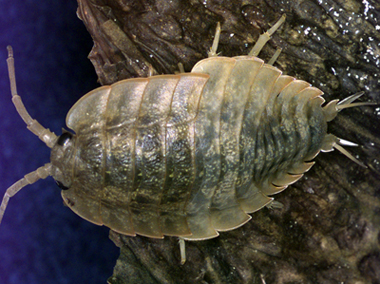
Fig. 1. A male Ligia pallasii has just moulted its posterior half and is now in intramoult phase. Note the larger size of the posterior half of the body as compared with the anterior unmoulted half. The posterior part is still soft, but is in the process of being mineralised. The ventral or sternal side of this individual bears the calcium stores to be used in this mineralisation. A day or so later the anterior half will be moulted
Like other crustaceans, isopods grow by periodic casting off of their exoskeletons in a process known as moulting. After the old exoskeleton is shed, the new soft cuticle is expanded to a larger size by hemolymph pressure from within. Over the next few days the new cuticle is strengthened and hardened by influx of calcium salts and other materials. In aquatic and semiterrestrial isopods the calcium may be obtained from abundant supplies in seawater, but in fully terrestrial species availability of calcium is limited to that found in soil and herbaceous foods. Calcium present in the old exoskeleton is therefore precious and must be salvaged. Moulting in most or all isopods is biphasic, with the posterior half being shed first, followed a day or so later (the intramoult period) by the anterior half (Fig. 1). During premoult of the posterior exoskeleton, calcium is resorbed and moved to the first four sternites of the thorax where it is temporarily sequestered in the form CaCO3 spherules. This stored calcium is later mobilised to harden up both the newly forming posterior exoskeleton and later the anterior exoskeleton. After a short period the same process occurs with the anterior half. During the resorption process the calcium-ion content of the hemolymph increases by 40 - 50% and this, combined with a smaller increase in potassium content, draws water in osmotically. The expanded hemolymph volume inflates the new, soft cuticle, and this expansion after hardening accommodates later tissue growth. After the anterior moult is completed the animal enters the intermoult phase. Length of intermoult is shorter in juvenile stage than in adult stage, where it may occur only once per year. Growth in all crustaceans is therefore a stepwise process.
NOTE lit. “that which is taken off” L., a term used in studies of insects, crustaceans, snakes, and other animals which cast off their exoskeletons or skins during growth
Test Your Understanding
What are the advantages of a biphasic moult in an oniscid isopod? Consider these possibilities, then check the explanations.
[Click each option to see commentary]
-
It is an energy-savings strategy.
Option a:
No, there is no evidence for this. On the contrary, it may be actually be more energy costly than a "regular" moult cycle.
[hide]
-
It allows for continued motility.
Option b:
Yes. An individual in either posterior or anterior moult is able to move about readily. For example, the individual featured in the preceding Research Study has four pairs of useful legs during its posterior moult and, later, will have three pairs for use during the anterior moult.
[hide]
-
It reduces evaporative water loss.
Option c:
Possibly. This has been cited by other authors as an advantage for terrestrial isopods, but it is not clear how it might work.
[hide]
-
It permits cycling of calcium for mineralisation.
Option d:
Yes, but this may be a consequence of a biphasic moulting cycle rather than a strict "advantage". Calcium is also sequestered in other crustaceans that go through a monophasic moult cycle.
[hide]
-
It ensures that sensory receptors (e.g., eyes, antennae, uropods) and defensive structures (e.g., repugnatorial glands) are always fully functional on one half of the body.
Option e:
Yes. This is a good point, and goes along with the second entry relating to continued motility.
[hide]
Research Study 2
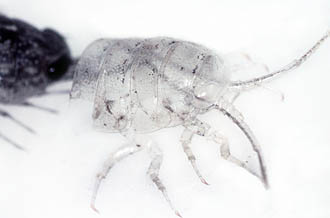
Fig. 1. Anterior moult or exuvia of Ligia sp., soon to be eaten
In marine isopods most or all of the calcium for mineralisation comes directly from seawater surrounding the animal. In comparison, semiterrestrial and terrestrial isopods obtain their calcium from food, or from freshwater or possibly ingested calcareous soils, and calcium is at more of a premium than it is for marine forms. The main nutritional requirement for calcium by isopods (and other crustaceans) is to replace that lost in the cast-off moult and to provide for growth of the new exoskeleton. In Ligia spp. (Fig. 1) about 25% of the calcium content of the exoskeleton is lost when it is moulted but, as ligiids normally eat their exuviae, the actual loss by this cause may be small.
NOTE a few terrestrial species, including Porcellio scaber (Fig. 2) are known also to consume their exuviae after moulting, and it may be a common behaviour throughout the oniscideans. Whether it is primarily for calcium-saving, or for resorption of general nutrients, is not known.
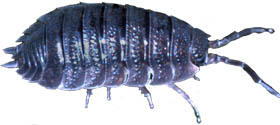
Fig. 2. Terrestrial woodlouse Porcellio scaber, common under flower pots, pieces of wood, and leaf litter in gardens
Carefoot & Taylor 1984 Comp Biochem Physiol 79A: 655
Research Study 3
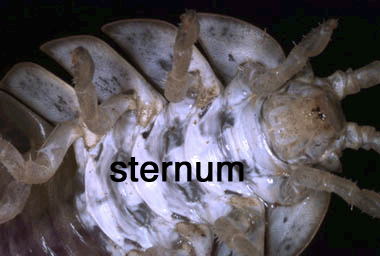
Fig. 1. Sternal calcium-carbonate deposits in a premoult Ligia pallasii
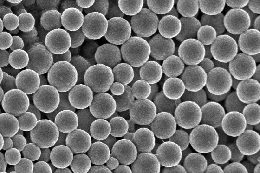
Fig. 2. Calcium-carbonate spherules in
Ligia italicaCourtesy Helge Fabritius and Andreas Ziegler, University of Ulm, Germany
Prior to the posterior moult, calcium and carbonate ions are resorbed from the old posterior cuticle and transported in the hemolymph across the anterior sternal epithelium into a space, known as the ecdysal gap (a space created as the old cuticle becomes hard and begins to split off), where they precipitate to form CaCO3 spherules. After the posterior part is moulted, the sternal calcium spherules are resorbed and used for the mineralisation of both the new posterior and anterior cuticles. The deposits are seen in Fig. 1 as white areas in the first four sternites of a moulting Ligia pallasii. In Ligia the deposits consist of microscopic spherules (0.5µm dia) of amorphous calcium carbonate precipitated within an organic matrix (Fig. 2). The large surface area and the amorphous state of the spherules facilitate their mobilisation and thus speed of mineralisation of the new cuticles. These calcium deposits are an adaptation to the terrestrial environment and do not occur in marine isopods.
NOTE lit. “escape or slipping out” G. Another word for moulting is ecdysis
NOTE non-crystalline. Solubility of calcium carbonate in its amorphous form is 10 times greater than in its crystalline form
Research Study 4
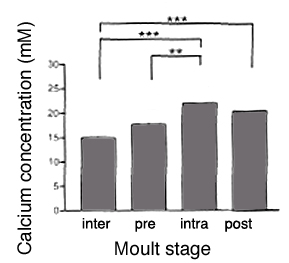
Fig. 1. Hemolymph calcium concentrations in Ligia pallasii in different stages of moult cycle
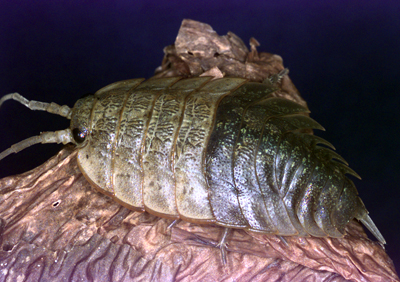
Fig. 2. Ligia pallasii prior to moulting the anterior half. Note the shiny, new appearance of the posterior exoskeleton
As noted in previous Research Studies, semiterrestrial and terrestrial isopod species have a biphasic moult involving stages of premoult, moult (posterior half), intramoult (between moult of posterior and anterior halves), moult (anterior half), postmoult, and intermoult. During these stages the hemolymph undergoes changes in ionic composition, most notably in titre of calcium, an element essential for construction of the new cuticle (exoskeleton) and one conserved during the moulting process. These changes are investigated for Ligia pallasii at the Bamfield Marine Sciences Centre, British Columbia by an international group of researchers. Calcium increases significantly by 18% from inter- to premoult owing to uptake from the posterior cuticle (Fig. 1). This calcium is transported in the hemolymph and precipitated as CaCO3 in storage areas under the anterior sternal cuticle. Later, from pre- to intramoult the calcium content of hemolymph increases significantly by resorption of calcium from the anterior cuticle and by mobilisation of these newly created anterior calcium-carbonate stores for formation of new cuticle. After the posterior cuticle is moulted there occurs a sudden increase in hemolymph volume that serves to expand the new cuticle in both halves of the body (Fig. 2). The increased volume subsides later during intermoult leaving space for later tissue growth. The absence of significant change in concentration of other ions (Na+, K+, Mg++, and Cl-) during the moulting period suggests that the increase in hemolymph volume may owe to uptake of seawater rather than freshwater.
NOTE this group, numbering 10 in total and calling themselves the International Isopod Research Group (IIRG), met at the Bamfield Marine Sciences Centre for a 6wk period in 1998 to research behavioural, physiological, and biochemical aspects of semiterrestrial life in L. pallasii. The 7 major papers resulting from this collaboration can be found in various locations in this section on TERRESTRIALISATION
Ziegler et al. 2000 J Comp Physiol B 170: 329
 Isopods