 Sea stars
 Research Study 1

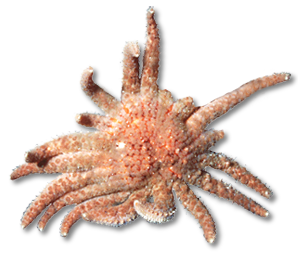
The sea star Luidia foliata commonly inhabits sand/mud habitats over which it can crawl quite quickly, possibly relating to the lack of suckers on the tube feet (Fig. 1). Thus, it moves tippy-toe fashion. Interestingly, its diet includes a range of invertebrates, including bivalves, but how it catches and manipulates its prey without suckers is not known. This might make a good a good student project at a summer marine station, if enough specimens could be found.
Research Study 2
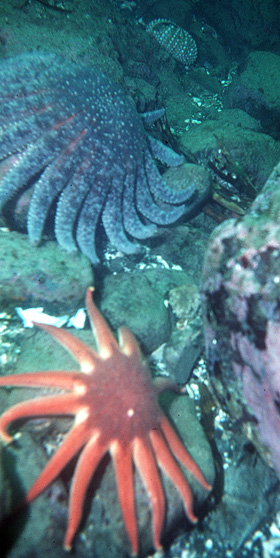
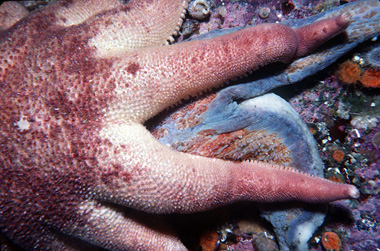
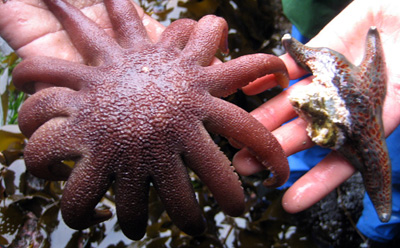
Subtidally, the most aggressive predator of west-coast sea stars is the sun star Solaster dawsoni. Responses of prospective prey species as observed at Friday Harbor Laboratories, Washington is to crawl away, and the ones listed below can often out-run the predator:
- Pycnopodia helianthoides (Fig. 1)
- Dermasterias imbricata (Fig. 2)
- Evasterias troschelii
- Mediaster aequalis
- Crossaster papposus
One species, Solaster stimpsoni even pushes back against the predator when attacked. A similar pushing defense is also used by S. stimpsoni to repel attacks by conspecifics.
Research Study 3
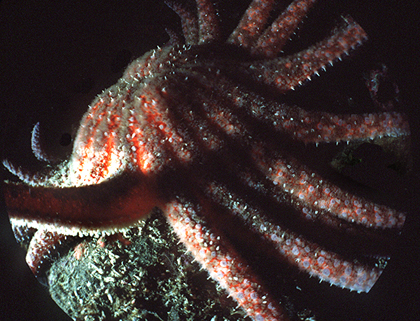
Subtidal measurements of Solaster dawsoni’s locomotory rate show a top chase speed of about 10cm • min-1. Interestingly, when touched by one of Solaster’s rays, even some sluggish-seeming species can outrun the predator. At crawling speeds of 120 - 160cm • min-1 the sunflower star Pycnopodia helianthoides is, of course, in a class by itself (Fig. 1), but even the normally quiescent Mediaster aequalis (33cm • min-1) and Crossaster papposus (65cm • min-1) easily outrun the predator. Of asteroids whose crawling speeds are recorded, the bat star Patiria miniata may be one of the slowest, at 6cm • min-1. It does not appear to be eaten by Solaster, however, perhaps for reasons of distastefulness or by living in habitats not frequented by the predator.
Kjerschow-Agersborg 1922 Biol Bull 42: 202
Rumrill 1989 Mar Ecol Progr Ser 56: 37
Research Study 4
Much the same kind of data for behavioural responses of asteroids to contact with Solaster dawsoni is presented in a study at the Bodega Marine Laboratory, California. Here, strong escape responses are displayed by Patiria miniata, Henricia leviuscula, Leptasterias hexactis, Pycnopodia helianthoides, and small Pisaster ochraceus. However, all the