Research Study 1
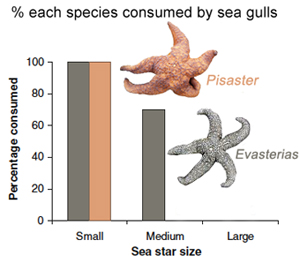
Fig. 1. Relationship of body size on predation by gulls Larus spp. for sea stars Pisaster ochraceus and Evasterias troschelii. Any size of Pisaster larger than small is avoided by the gulls
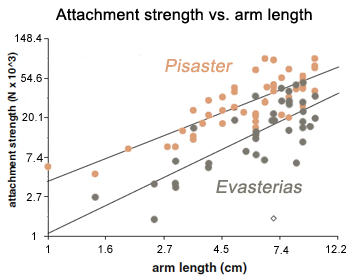
Fig. 2. Effect of arm length on attachment strength of sea stars Pisaster ochraceus and Evasterias troschellii
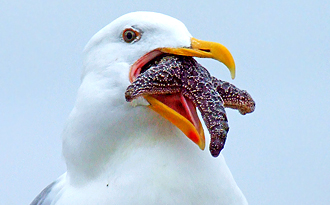
Fig. 3. In areas of Puget-Sound, sea stars appear to be the primary prey of sea gull
s. Small- to medium-sized sea stars, such as shown here, are generally swallowed whole. Time to ingestion varies from seconds to hours depending on size of prey. Here, a glaucous-wing gull
Larus glaucescens eats an ochre star
Pisaster ochraceus and, from here, it may be a long while until complete ingestion
Courtesy Jeff Masters, Michigan myvalleylll
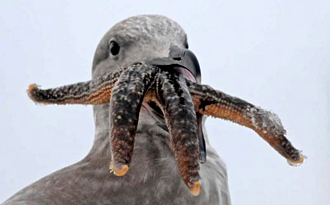
Fig. 4.
Larus sp. eating a mottled star
Evasterias troschelii
Courtesy Bob Armstrong and Juneau Empire, Alaska
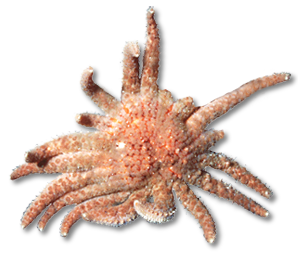
As part of a general survey of habitats occupied by Pisaster ochraceus and Evasterias troschelii in Puget Sound, Washington researchers from Friday Harbor Laboratories document predation on both species by gulls Larus spp. Smaller sizes of both prey species are generally preferred, likely explained by the fact that the gulls find pecking bits from a sea star less preferable than swallowing them whole (Fig. 1). Note that only small-sized Pisaster are eaten and no large individuals of either species are eaten. The gulls prefer Evasterias over Pisaster (88% vs. 12%, respectively) possibly owing to its generally less bulky shape and to the fact that Evasterias anchors by its tube feet significantly less securely than Pisaster (Fig. 2). These data show that Pisaster attaches with 1.3 times greater strength than Evasterias. With respect to habitats occupied, there is an ontogenetic shift in preference, with the smaller more vulnerable sizes of both species favouring crevice microhabitats possibly for predation refuge. As the sea stars become larger and enter size refuge (from gull predation?), they tend to move out into open areas such as rocks or pilings and docks, with less structural complexity, but more abundant and larger food resources in the form of barnacles and mussels.
NOTE glaucous-wing Larus glaucescens and possible hybrids with western gulls Larus occidentalis
NOTE anchoring force is assessed using a cable tie attached at the base of one arm and a spring balance. The data in Fig. 2 are presented as antilog equivalents of the natural log values used originally by the authors, for visual clarity (thus explaining why they are not whole numbers). However, other than to spread out the data, it is not clear why the authors choose to graph the data logarithmically. Because attachment strength depends on tube-foot number, and thus directly on arm length, then the relationship would be expected to be linear. No transformation would be necessary for a straight-line relationship. This unnecessary transformation does not at all affect the validity of the data
Rogers & Elliott 2013 Mar Biol 160: 853
 Sea stars