Research Study 1
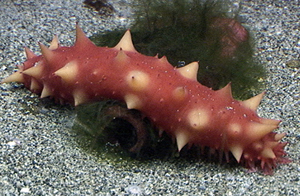
Fig. 1. A juvenile Apostichopus californicus (length, 5cm). At this early age the tubercules retain features of the tube feet, including an open pore at the end, from which they ancestrally derived
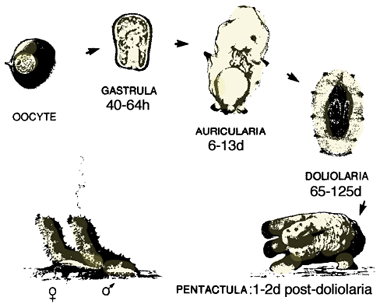
Fig. 2. Life cycle of Apostichopus californicus. Metamorphosis occurs after the auricularia larval stage. When the pentacula drops out of the plankton and begins crawling, it can be considered an early juvenile stage
In laboratory culture of eggs of Apostichopus californicus (Fig. 1) a blastula stage is reached after 24h, a hatched gastrula by 64h, and a feeding auricularia larva after 13d (at 10 - 12°C). Metamorphosis is of a gradual kind, first to a doliolaria stage occurring at 65 - 125d, and then to a pentacula stage occurring 1 - 2d later (Fig. 2). The early pentacula remains pelagic at first, but then, as more adult features develop, settles to the sea bottom. The young pentacula can crawl about using its tube feet and tentacles. Sexual maturity is attained after about 4yr in field populations. In comparison with most other echinoderms this seems a long time.
Fankboner & Cameron 1989 J Exp Mar Biol Ecol 127: 43
Research Study 2
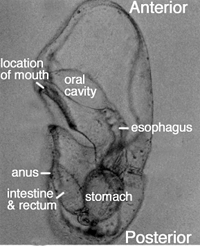
Fig. 1. Auricularia larva of Apostichopus californicus showing features of the gut system. The author shows the mouth to be at the opening to the oral cavity, but in other reports it is shown as being within the oral cavity at the anterior end of the esophagus. The larva is about 400µm in length
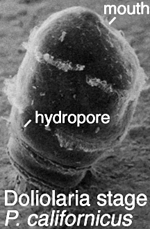
Fig. 2. Mid-metamorphic doliolaria stage of Apostichopus californicus showing mouth developing at anterior end
Isolation and purification of an oocyte-maturation hormone in Apostichopus californicus has permitted controlled induction of meiosis and fertilisation in the resulting ova, and has enabled detailed analysis of metamorphic events. The researcher also describes a gradual kind of metamorphosis that commences 3 - 5wk after fertilisation, the precise time depending upon seawater temperature, feeding regime, and source of eggs. Four hours after commencement of metamorphosis the feeding auricularia larva (Fig. 1) changes to a non-feeding doliolaria (Fig. 2). At about 24h after commencement of metamorphosis, other changes lead to the formation of a pelagic stage1, wiith the oral opening now at the anterior end. Shortly thereafter the juvenile2 settles to the sea bottom and assumes the adult crawling mode of life. The gradual change from auricularia to juvenile explains the variability in interpretation of the steps of metamorphosis.
NOTE1 considered by some authors to be still a doliolaria
NOTE3 note that this is equivalent to the pentacula stage noted in Research Study 1 above
Smiley 1986 Biol Bull 171: 611
Research Study 3
During metamorphosis, as in other echinoderms, the larvae of holothuroids change from bilateral to pentaradiate symmetry. This is seen mainly in the radial structure of the water vascular system, including tube feet and associated tentacles. Superimposed on this adult radial symmetry in sea cucumbers, however, is a derived bilateral symmetry, evident externally in the division of the body into a lowermost trivium and uppermost bivium, and internally by the bilateral nature of the complex hemal system and associated gut tube, as well as paired respiratory trees, and so on. Traditional thinking is that phylogenetically, holothurians evolved from ancestors with a primary radial symmetry and later adopted a crawling habit of life with accompanying secondary bilaterality. The later imposition of radial symmetry is therefore generally considered a tertiary event in their evolution. However, based on the observation that during metamorphosis the bilateral features of a juvenile Apostichopus californicus derive directly from the bilaterality of the auricularia larva, the author of the present research study argues that the bilaterality is not a secondary feature; rather, that the pentaradiate symmetry of the adult should be considered a secondary feature.
NOTE these are rows of tube feet, three on the lower surface and two on the upper
NOTE consideration of symmetry is always interesting but, from an objective viewpoint, it seems that this author's argument is one of semantics, revolving around whether the primary symmetry is the radiality of the ancestor or the bilaterality of the larva. It is not known how extensively the author's proposal has filtered down into current-day thinking, but perusal of three of the most popular invertebrate texts currently in use shows just cursory references to the general topic of symmetry, and no references at all to this specific idea. Best to forget it and move on...
Smiley 1986 Biol Bull 171: 611
Research Study 4
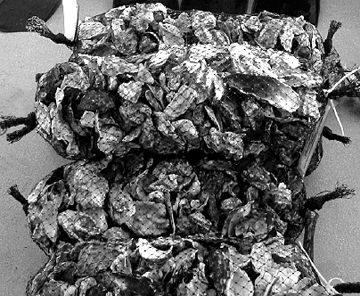
Fig. 1. Bags of oyster cultch used to collect juvenile Apostichopus californicus
Should you ever have a need for juvenile Apostichopus californicus in your research, scientists at the Washington Department of Fish and Wildlife have devised a useful means of collecting them. They use a mesh bag filled with cultch (shells) of Pacific oysters Magallana gigas (Fig. 1). Bags are placed at three depths (3, 5, and 7m). Deployment of 33 such bags over a 8mo period commencing in spring at three sites in Puget Sound, Washington yielded 13 juveniles (3 - 85mm in length, Fig. 2), along with representatives of over 40 other marine species including several fishes. Eleven of the Apostichopus were caught in bags moored at 7m depth, and 9 of these bags were at a rocky site.
NOTE this does not seem a lot over such a long time, but the method is simple and relatively inexpensive
Cheng & Hillier 2011 J Shellf Res 30 (1): 65
 Sea cucumbers