Research Study 1

Fig. 1. Spawning Apostichopus californicus

Fig. 2. This spawning male Apostichopus californicus appears to be releasing its sperm from one of the tubercles on the upper surface. The tubercles are hollow and do communicate with the coelomic cavity, but it would be unusual for the testes to release their product into the coelom. if you follow the sperm trail down and along, you can see that it appears to originate at the anterior end, presumably from the gonopore sited in the tentacle ring
In many species, including Apostichopus californicus, spawning individuals raise up their front ends so that the gametes are released well free of the sea bottom (Fig. 1). The gametes stream from a single gonopore within the ring of tentacles (but see Fig. 2), and fertilisation takes place in the open water. The eggs are relatively large and yolky in sea cucumbers, and develop to a feeding larval stage known as an auricularia. After a 3 - 5wk period floating in the plankton, the larvae metamorphose and settle to the sea bottom.
NOTE lit. “ear” L., owing to the sinuous appearance of its ciliated bands the larva somewhat resembles a human ear
Cameron & Fankboner 1986 Can J Zool 64: 168
Research Study 2

Fig. 1. A male Apostichopus californicus stretches out to spawn. The sperm is visible as a milky string about three-quarters of the way up the stretched part, on the upper surface. The light-coloured dots may well be eggs
Male and female Apostichopus californicus sometimes intertwine their bodies and/or sway from side to side as they spawn, thus ensuring maximum fertilisation (Fig. 1). The eggs are light orange in colour and are slightly buoyant. Both sexes are “dribble” spawners, and have an extended spawning season (April - August) in the San Juan Islands and British Columbia areas.
McEuen 1988 Mar Biol 98: 565
Research Study 3
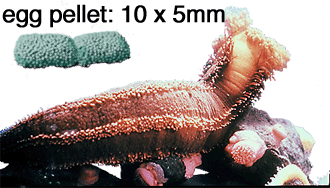
Fig. 1.
Cucumaria miniata in a laboratory aquarium with superimposed egg pellet, with size indicated
Courtesy Ron Long, Simon Fraser University, Burnaby, British Columbia

Fig. 2. Cucumaria miniata releasing an egg pellet from its single gonopore
Cucumaria miniata spawns March - May in San Juan Islands, Washington. Eggs are greenish in colour and are released as compacted pellets (10 - 13mm length x 3 - 6mm dia) that float to the surface and break apart after about 20min (Fig. 1). Females spawn from a single gonopore, but males may spawn from up to 9 gonopores. Individuals of both sexes may stretch upwards into the water column when spawning. Usually a male spawns first and creates a domino effect downstream in both males and females. In Fig. 2 a female is releasing a compacted egg pellet.
Shimek 1987 Nat Hist (3): 60
McEuen 1988 Mar Biol 98: 565
Research Study 4

Fig. 1. Several Cucumaria miniata in a rocky area around Bamfield, British Columbia
Eggs collected soon after release or later at the sea surface following a mass spawning of Cucumaria miniata in the Bamfield area of British Columbia (18 - 19 March, 1991) are 87 - 97% fertilised. In this incident most spawning took place within 1.5h following slack low tide, although some individuals were still spawning up to and past the next high tide. In this area mean densities are 46 individuals • m-2, and 95% of females are within 20cm distance of a conspecific individual – half of which are presumably males (Fig. 1). Each female may release up to 130,000 eggs.
Sewell & Levitan 1992 Bull Mar Sci 51: 161
Test Your Understanding
Select the single factor in the list below that does NOT correspond with what you know about conditions for optimal fertilisation success in Cucumaria miniata, then check the explanations.
[Click each option to see commentary]
-
Aggregated distribution.
Option a:
Answer to quiz about the least optimal condition for fertilisation success in Cucumaria miniata:
- aggregated distribution
- synchronous spawning
- low tide slack
- males downstream from females
- slow current flow
NOTE the highlighted factor is the one that the reader should have selected, based on what was presented in the previous Research Studies, but it is a bit of "red herring". When you think about it, being upstream or downstream for either sex is about the same, especially given the varying directionality of tidal currents and wave action. Also, in many or most species, the presence of gametes in the water from either sex may be the stimulus required for spawning in a downstream individual, whether it be the same, or opposite, sex. This appears not to be known for Cucumaria miniata
[hide]
-
Synchronous spawning.
-
Low slack tide.
-
Males downstream from females.
-
Slow current flow.
Research Study 5

Fig. 1. Sea cucumber Eupentacta quinquesemita showing feeding behaviour
Eupentacta quinquesemita (Fig. 1) spawns during May - June in San Juan Islands, Washington. Eggs are light green or olive-green in colour, are slightly buoyant, and are released as a loose rope that soon breaks apart. Females have one gonopore, but males have between 4 - 19.
McEuen 1988 Mar Biol 98: 565
Research Study 6

Fig. 1. Sea cucumber Psolus chitonoides. The mouth is within the tentacles at the front; the structure equidistant towards the back is the anus covered with protective plates
Psolus chitonoides spawns March - June in San Juan Islands, Washington (Fig. 1). Eggs are red or brick-red in colour and are released as a tightly packed, cylindrical egg strand (5mm dia) that fragments as it floats to the sea surface.
McEuen 1988 Mar Biol 98: 565
 Sea cucumbers