Research Study 1
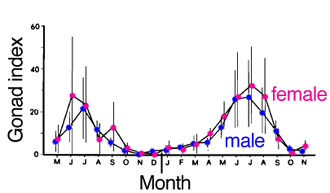
Fig. 1. Cycle of gonad growth in Apostichopus californicus, with spawning commencing late summer
In Indian Arm, British Columbia, gonads of Apostichopus californicus develop through the summer and spawning is in late summer/early autumn (Fig. 1). Sex ratios are not significantly different from a 1:1 ratio, and spawning is partially synchronous. Gonad indices are similar in the two sexes. (For a detailed study on oogenesis in A. californicus see Smiley, 1988).
NOTE calculated as volume of gonad/fresh body mass (minus gonad and coelomic fluid) X 100. This is an unusual method of calculating a gonad index and makes it all but impossible to compare these results with those of other studies. For the more usual method, see Research Study 2 below
Cameron & Fankboner 1986 Can J Zool 64: 168
Smiley 1988 Biol Bull 175: 79
Research Study 2
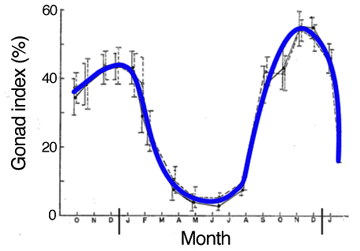
Fig. 1. Gonad indices of Cucumaria pseudocurata in California
Around Sonoma County, California the black sea cucumber Cucumaria pseudocurata lives among sea mussels and on partially protected, vertical rock surfaces from the lower part of the mussel-bed to zero tide-mark. It is a brooding species. Gonadal indices are highest in winter and lowest in summer (Fig. 1). Spawning by males and females is synchronous, and occurs Jan - Mar. Egg numbers per individual are dependent on size, and can reach over 300 in the largest females (>70mg live mass). Following their release, the eggs are held under the female’s body for about a month until they hatch.
NOTE calculated as dry mass of gonad/dry body mass (including gonad) X 100. There are two lines on the graph representing the two sexes but, as the sexes do not differ significantly from one another, they are indicated here by a single blue line
NOTE in comparison with other echinoderms such as sea urchins, sand dollars, and sea stars, this seems like an extraordinarily small number of eggs even for a small-sized adult female
Rutherford 1973 Mar Biol 22: 167
Research Study 3
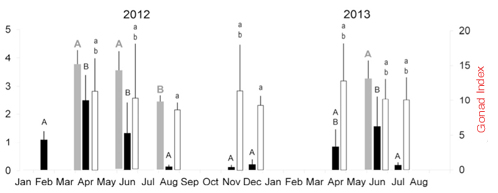
Fig.1. Gonad indices of Apostichopus californicus in Ketchikan Harbor, Alaska, over a two-year period. Sexes appear to be combined in the data, which could be considered a waste of potentially useful data. The graph is a bit hard to follow, and has been truncated somewhat from its original form. Gonad indices are represented by the 9 black bars. The other sets of bars represent female gonad indices corrected in some way, and female gonad lipid values, but these two bar fillings (i.e, white and gray) are not identified in the legend for the graph. Letters above each bar indicate statistical homogeneity
Gonad indices in Apostichopus californicus in southeast Alaska are reported by fisheries scientists at the University of Alaska to peak in April, wih spawning taking place May - July (Fig. 1). This is about two months earler than reported for the same species in southern British Columbia (see Cameron & Fankboner, 1986). Eggs are fertilised in the water column.
NOTE gonad indices are generally calculated as the ratio of gonad mass to some unit of body mass. The authors are unclear on the actual method they used, whether it is "ratio of gonad to body weight" or "ratio of gonad to body-wall wet weight" as they include both definitions. The main questions relating to the methodology actually used are: 1) are sexes combined into a single index?, 2) is the mass of all internal organs included along with body wall, with only coelomic fluid missing?, and 3) is gonad mass included along with body wall and other organs in the denominator? These are important questions when comparisons are being made between different species or between different studies.
NOTE lipid contents of the gonads are also determined and are also shown in Fig. 1, but not discussed in this short account
Whitefield & Hardy 2019 J Shellf Res 38 (1):191
 Sea cucumbers